
Contents
- Which ATP table should you use?
- Why can the same player have different positions?
- What does “defending points” mean?
- How are Live Rankings different?
- Does being eighth in the Race guarantee an ATP Finals place?
- Which results count at the Finals cut-off?
- Before using a ranking in a prediction
- Sources and current tables
A player can be near the top of the ATP Rankings but much lower in the ATP Race without either table being wrong. The Rankings normally look back over 52 weeks; the Race follows the season’s points. A third table, the Live Rankings, updates the rolling-ranking picture as tournament results arrive.
Use the Rankings for a player’s official standing, the Race to follow the season’s contest for Turin, and Live Rankings to understand what this week’s results could change. This guide covers men’s singles. [2–4]
Which ATP table should you use?
| Your question | Start here | What to keep in mind |
|---|---|---|
| Who is officially world No. 1? | PIF ATP Rankings | A temporary live lead is not an official ranking milestone. |
| Which ranking informs tournament entry and seeding? | PIF ATP Rankings | Apply the event’s entry and seeding rules, not a live projection. |
| Who is doing best in the season’s race toward Turin? | PIF ATP Race to Turin | Finals selection includes a cut-off and a Grand Slam champion provision. |
| What could today’s win change? | PIF ATP Live Rankings | These anticipate the next published Rankings; points added and dropped both matter. |
The Race is useful for comparing the season so far. The rolling Rankings answer a broader question because eligible earlier results can still contribute. Neither table is a forecast of who will win the next match. [2–4]
Why can the same player have different positions?
Imagine two players at the same point in a season. To keep the example simple, assume the season results shown count in both calculations and there are no replacement, penalty or timing complications.
| Illustrative points | Player A | Player B |
|---|---|---|
| Earlier results still in the rolling total | 3,500 | 800 |
| Counted season results | 1,100 | 2,200 |
| Rolling total in this example | 4,600 | 3,000 |
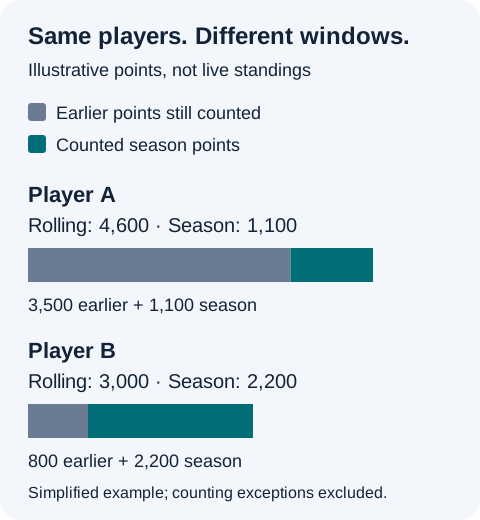
Player A leads this two-player rolling comparison by 1,600 points. Player B leads the season comparison by 1,100. The difference comes from the results included, not an error in addition.
These are invented examples, not live standings. A real player’s breakdown must also satisfy ATP counting rules; adding every tournament result is not a reliable shortcut. [1, §9.03]
What does “defending points” mean?
It describes an older result approaching its removal from the rolling calculation. It does not mean the player starts a new match owing points.
Consider an illustrative player with 2,000 rolling points, including an old 100-point result. Suppose that result expires and a new 250-point result counts in full, with no other changes:
2,000 − 100 + 250 = 2,150 points.
The net increase is 150, not 250. If the new counted result were 50 instead, the total would be 1,950: a 50-point decrease despite adding a result.
In practice, an eligible result previously outside the counted breakdown can sometimes replace one that drops out. A new result can also need to exceed an existing counted score before it improves the total. Check the player’s breakdown rather than subtracting a headline number automatically. [3]
Does every result expire at exactly the same time?
No. Under the 2026 rules, Finals points drop on the Monday after the following year’s last ATP Tour event. ITF results enter on the second Monday after their tournament week; once entered, they stay for 52 weeks. [1, §9.01E]
That is why “roughly the past year” is a useful introduction, but not a complete calculation method.
How are Live Rankings different?
Live Rankings look ahead to the next published table. They account for points dropping in the tournament week and update as relevant results arrive. Their starting total can therefore differ from the published Rankings before the player plays. [3]
Read the column labels carefully:
- Official points: the published total.
- Live points: the developing calculation.
- Next points: the total if the player wins his next match.
- Max points: the total if he wins the tournament. [3]
“Next” and “Max” are scenarios, not points already earned. If you compare screenshots from different times, check whether they show the same table, week and column before concluding that one is wrong.
Does being eighth in the Race guarantee an ATP Finals place?
No. The 2026 singles selection procedure has an important Grand Slam champion provision.
For Finals acceptance, the 2026 rulebook specifies the PIF ATP Rankings on the Monday after the Rolex Paris Masters. Its selection list puts the first seven players first, followed by up to two current-year Grand Slam champions ranked eighth to 20th, in ranking order, then the remaining players from eighth down. Only the first eight on that selection list qualify directly; withdrawals and alternates are handled separately. [1, §4.01]
For example, assume no withdrawals and an eligible current-year Grand Slam champion at No. 12, with no higher-placed champion in the No. 8–20 range. He takes the eighth direct place ahead of a non-champion at No. 8. With two eligible champions in that range, the higher-ranked takes that direct place and the lower-ranked is the alternate. A Slam title from an earlier year does not meet the condition. ATP’s Rankings FAQ explains this priority in Race terms. [2]
This does not mean you must wait until the cut-off for every qualification announcement. ATP can confirm players who have already secured their places. What you should avoid is treating an unfinished eighth-place position as a guarantee. [6]
Which results count at the Finals cut-off?
Finals qualification has its own cut-off. Under the 2026 rulebook, the acceptance cut-off is the Monday after the Rolex Paris Masters. Results from ATP Tour tournaments in the following week count toward the following year’s Finals acceptance. [1, §4.01]
Read the sequence this way:
- Follow the season’s Race as results develop.
- Apply the specified acceptance snapshot and selection priorities.
- Keep later results separate when checking that edition’s acceptance.
Acceptance, tournament seeding and year-end ranking are different questions. Do not assume that a Race table and any particular dated Rankings table must have identical points. The rule’s following-week treatment is also why a simple January-to-December description can miss an important qualification detail.
Before using a ranking in a prediction
Write down what you are actually assessing: an individual match, an official ranking position or a Finals berth. Then choose the corresponding table and date.
For a match, investigate the surface, opponent, recent performance and any reliable fitness information rather than turning ranking position directly into a win probability. For a Finals place, look at the remaining opportunities, selection conditions and ATP announcements. If a prediction market is involved, read its settlement wording: “qualifies,” “participates” and “wins” describe different outcomes.
The practical shortcut is simple: official standing → Rankings; season progress → Race; developing weekly movement → Live Rankings. Follow the relevant conditions before turning any of them into a conclusion.
Keep learning
Explore educational guides. These links do not open trading markets.
Sources and current tables
- 2026 ATP Official Rulebook, hosted by the ITF, §§4.01, 9.01 and 9.03. ATP rulebook index and amendments.
- ATP Rankings FAQ, including the Race and Finals selection explanation. The Rulebook controls if the summary conflicts with it.
- ATP Live Rankings FAQ, for published, live and projected totals. Its older round-by-round numerical examples are not used here as the 2026 points table.
- Tennis Explained: How the Tour Ticks, for the basic purpose of the Race. Its simplified season description does not override the 2026 cut-off rule.
- Official Race to Turin table. Check its date, column labels and ATP qualification announcements for the current picture.
- ATP’s September 2024 qualification announcement, a historical example of a berth being secured before the late-season cut-off, not a statement about the 2026 field.
Rules checked on 22 October 2026. No current player positions or qualified-player list are asserted here.
Share this guide