
Contents
A U.S. government shutdown concerns whether affected agencies have funding authority to carry out their work. A debt default concerns a failure to make a debt payment when due. A dispute over the debt limit can threaten the government's ability to pay its obligations, but reaching that limit is not the same event as missing a payment.
To read a headline accurately, separate three questions: Is an appropriation available? Can Treasury finance payments? Has a specified payment actually been missed? These questions can be related politically without having the same legal or financial trigger. GAO's shutdown explanation, Congressional Research Service on a binding debt limit
The distinction at a glance
| Question | Government shutdown | Debt-limit impasse and possible default |
|---|---|---|
| What is the immediate constraint? | An appropriation has expired without replacement funding for an affected activity. | A borrowing limit constrains Treasury's financing options; payment capacity also depends on cash and other available resources. |
| What must you establish? | Which funding has lapsed, and which activities lack available funding or an applicable exception? | Whether resources can cover obligations when due, and whether a particular payment has actually been missed. |
| What can continue? | Activities with available funding and activities covered by an exception may continue. | Reaching the limit need not cause an immediate missed payment while other resources remain available. |
| What resolves the specific constraint? | Enactment of the necessary appropriations, including temporary funding where applicable. | Legislative action on the debt limit addresses the borrowing constraint; the payment question still requires evidence about the obligation and payment. |
| What should you not infer? | That every federal operation stops or all government payments cease. | That hitting the ceiling, an X-date estimate or a ratings change is itself a missed Treasury debt payment. |
The shutdown side follows GAO's explanation of appropriations lapses. The financing side follows Treasury's debt-limit guidance and CRS's analysis of cash, borrowing authority and payment capacity. GAO, Treasury, CRS
What a shutdown changes
A shutdown begins with a lapse in appropriations: the period after funding authority expires and before replacement funding is enacted. It often arises around a funding deadline when neither a regular appropriation nor a continuing resolution has taken effect. A continuing resolution is a temporary funding measure, not a change to the debt ceiling.
The Antideficiency Act generally prevents agencies from incurring obligations or making payments without available appropriations. That is why an affected agency cannot simply keep all of its ordinary work going on the assumption that Congress will provide the money later. GAO's overview
But “the government has shut down” is an incomplete description. Funding may lapse for only part of the government. Even within an affected agency, the answer can depend on the particular activity.
GAO describes a two-step test:
- Is funding already available for that activity? Multi-year, no-year, permanent or other available appropriations can allow it to continue.
- If funding is unavailable, does an exception to the Antideficiency Act apply? Certain activities may continue under a narrow exception, including qualifying work necessary to protect human life or government property.
These are different reasons for continuing. An activity with funding does not need to be squeezed into an emergency exception. Conversely, the fact that work is important does not automatically make it excepted. GAO warns that the narrow exceptions do not cover ongoing regular functions simply because they are useful. GAO's two-step inquiry
This also explains why a broad promise about payments is unreliable. A program may have continuing funding while some administrative services are disrupted. For an individual benefit, salary, contract or appointment, check the responsible agency's current instructions rather than extrapolating from the word “shutdown.”
What the debt limit changes
The debt limit constrains the amount of debt the federal government is authorized to incur. It does not itself authorize a new spending program. Treasury describes it as financing existing legal obligations, including obligations created through earlier spending and tax decisions. Treasury debt-limit guidance
That separates two parts of the process:
- An appropriation or other legal authority concerns the government's authority to incur obligations and spend.
- Cash and financing concern how payments are made when obligations come due.
An agency can have spending authority while Treasury faces a financing constraint. Equally, Treasury can have cash while an agency lacks authority to carry out an activity whose appropriation has lapsed. Neither situation can be understood from the government's bank balance alone. CRS's distinction between debt-limit episodes and appropriations lapses
Raising or suspending the debt limit therefore does not, by itself, reopen an agency whose funding has expired. Passing an appropriation does not, by itself, remove a binding debt limit. A single law can address both issues, but the mechanisms remain separate.
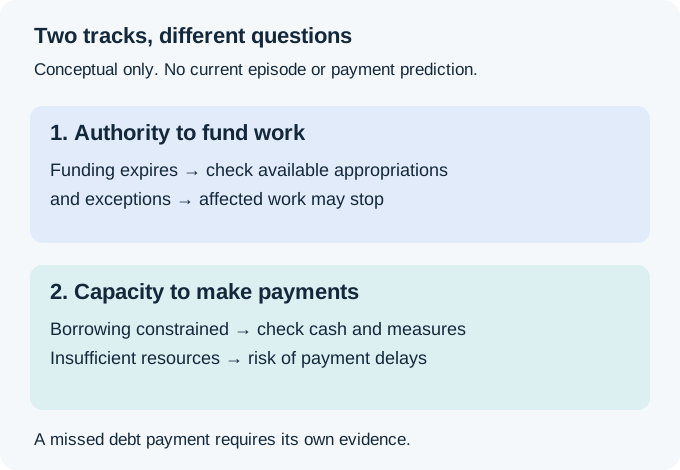
Figure: A conceptual reading aid, not a timeline of a current dispute. Funding authority and payment capacity must be checked separately.
Why reaching the ceiling is not immediate default
A headline about the debt ceiling can refer to several different stages:
- Debt reaches the applicable statutory limit, constraining additional borrowing.
- Treasury uses available cash and authorized extraordinary measures to continue meeting obligations.
- Those resources become insufficient to pay all obligations when due unless the constraint is addressed or other funds are available.
- Evidence establishes that a particular obligation was not paid on time.
These stages should not be collapsed into one date. Extraordinary measures are authorized financing and accounting actions that temporarily create room to operate under the limit. They do not repeal it or provide unlimited resources. Treasury's available cash, incoming receipts and payment schedule also matter. CRS, “Some Definitions” and debt-management discussion
The “X-date” is commonly used for an estimate of when Treasury would be unable to meet all obligations with the resources available. An estimate can change as information about receipts and payments changes. It is a warning about capacity, not a certificate that a specific debt payment has already failed. GAO on X-date uncertainty
There is no need to attach a current ceiling amount or predicted X-date to understand this distinction. To assess a particular episode, use the dated Treasury communication for that episode and check whether a later law or letter has superseded it. Treasury's archive of debt-limit communications
Be precise about what “default” means
This guide uses “debt default” in the narrow sense of failing to pay Treasury debt principal or interest when due. Broader discussions sometimes use “default on obligations” to include delayed non-debt payments, such as other amounts the government legally owes. Those broader payment failures matter, but they are not identical to a missed debt-service payment.
CRS documents disagreement about the definition of federal default and notes that credit-rating agencies use their own definitions. A news report, rating decision and event contract may therefore apply different tests. Read the stated definition rather than assuming that a familiar word has one universal operational meaning. CRS, “The Definition of Federal Default Is Contested”
Do not assume that a payment-prioritization proposal guarantees any recipient will be paid. Legal authority, operational feasibility and the consequences of delayed payments are separate issues. This article does not predict which payments would be delayed in a hypothetical financing crisis.
Three headlines, three different questions
Consider these invented headlines:
- “Funding expires for several agencies.” Ask which appropriations lapsed and which activities have other funding or an exception.
- “Treasury begins extraordinary measures.” Ask what borrowing constraint applies and what resources remain. This does not establish a missed payment.
- “A Treasury interest payment was not made when due.” Ask which security, due date and evidence are involved, and what definition the report uses.
A rating downgrade or a market-price move would be another kind of evidence. It can reflect an assessment of risk, but it does not replace proof of the particular event being discussed.
Read an event question before treating it as resolved
If you are evaluating a forecast or event-market question, start with its exact wording. “Will a shutdown begin?” could differ materially from “Will a shutdown last through a specified date?” “Will the debt limit be raised?” differs from “Will Treasury miss an interest payment?”
Record five things:
- The event being tested, including whether it covers a partial shutdown or a specified debt payment.
- The deadline, time zone and any duration requirement.
- The named official source or other settlement evidence.
- Whether a threat, legislative vote, enacted law or completed payment is required.
- What happens if the evidence is delayed or the terms are ambiguous.
This is a reading method, not a claim about any currently offered market. A political agreement announced in the news may still be different from the enacted law required by a question's wording.
The useful next check
For a shutdown question, find the applicable funding measure and the affected agency's current operating notice. For a debt-limit question, find Treasury's dated communication and the enacted legislation. For a default question, identify the specific obligation and the evidence about whether it was paid when due.
Keeping those checks separate lets you follow a complicated story without treating every funding dispute as a debt crisis or every debt-limit warning as an event that has already happened.
Continue learning
Choose another explanation for the question you want to check next.
Sources
GAO: Shutdowns/Lapses in Appropriations: funding lapses, the Antideficiency Act and the two-step continuation test.
CRS: A Binding Debt Limit: Background and Possible Consequences, October 4, 2024: mechanism and terminology. Episode-specific amounts and forecasts in that dated report are not presented as current.
U.S. Treasury: Debt Limit: financing existing obligations and dated official communications.
GAO: Debt Limit, December 11, 2024: the distinction between resource exhaustion, payment risk and an inherently imprecise X-date estimate.
HypaForecast publishes educational guides and operates a prediction market. This page is an educational explanation.
Share this guide