
On this page
Japan's active vs new job openings ratio: what changes?
Japan's new job openings-to-applicants ratio covers vacancies and job-seeking applications newly accepted during the month. The active ratio also includes valid carryovers from the previous month. That difference changes both sides of the calculation, so the two ratios can tell different stories about the same month.
Start with the series name, not just the number. These are measures of vacancies relative to job seekers in Japan's public employment office statistics. They are not your probability of getting hired.
The difference at a glance
| Measure | Vacancies counted | Denominator |
|---|---|---|
| New job openings-to-applicants ratio | Newly accepted vacancies | Newly accepted applications for job-seeking services |
| Active job openings-to-applicants ratio | Valid unfilled vacancies carried over, plus new vacancies | Valid unplaced job seekers carried over, plus new job-seeking applications |
In other words, “new” measures what was newly accepted, while “active” includes eligible carryovers. The active counts are monthly totals under these definitions, not simply the number left at month-end. MHLW definitions
What does “applicants” mean here?
The English label can be misleading if you read “applications” as applications sent to individual employers. The new ratio's denominator is newly accepted job-seeking applications at the public employment offices. It is not a count of résumés sent to vacancies, or a count of people who became unemployed that month.
On the other side, vacancies mean the number of people employers plan to hire, not the number of job advertisements. One advertisement is not necessarily one vacancy. The active calculation adds only still-valid carryovers: unfilled vacancies and job seekers whose employment has not yet been decided. Definitions, items 7, 8, 10 and 11
The statistics cover activity handled by public employment offices, commonly called Hello Work, and exclude new school graduates. They are not a census of every vacancy or every job seeker in Japan. Statistical scope
A worked example: the same month, two ratios
The figures below are fictional, unadjusted counts for one illustrative month. They are not actual Japanese monthly data.
| Component | Vacancies | Job-seeking side |
|---|---|---|
| Newly accepted this month | 120 | 60 new job-seeking applications |
| Valid carryovers from the previous month | 80 | 140 job seekers |
| Monthly active total | 200 | 200 |
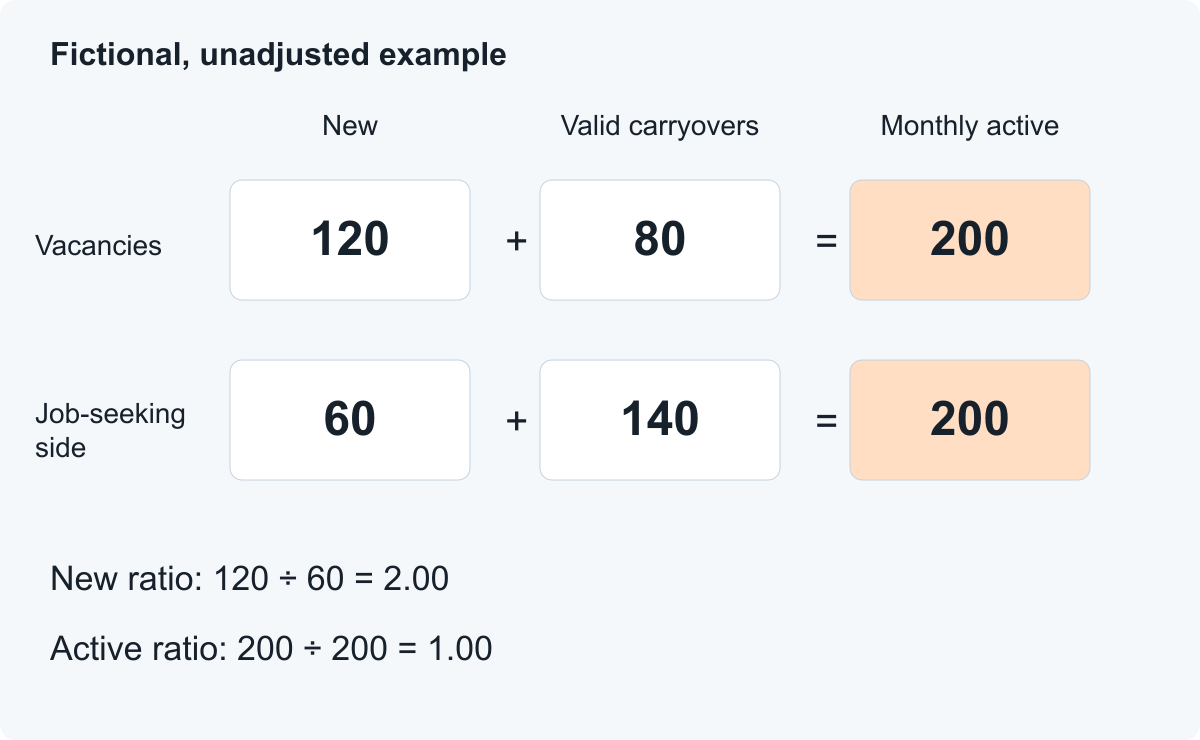
New ratio: 120 ÷ 60 = 2.00.
Active ratio: (80 + 120) ÷ (140 + 60) = 200 ÷ 200 = 1.00.
The new ratio is higher in this example because the carried-over group has fewer vacancies relative to job seekers. Neither calculation is wrong. They cover different combinations of new entries and carryovers.
A ratio of 2.00 is not a 200% chance of being hired. It compares the two totals; it does not match each person to a suitable job. Nor do the formulas require the new ratio always to exceed the active ratio.
Five checks before comparing published figures
- Period: Compare the same month when contrasting the two ratios. When tracing change, keep the series consistent across months.
- Coverage: Check whether part-time work is included, excluded or reported separately. Do not assume that a regular-employee series uses the same denominator as the general series.
- Geography: Keep national and prefectural figures separate. For regional vacancies, distinguish the office's acceptance location from the job's work location.
- Adjustment: Use the same seasonal-adjustment basis. An unadjusted calculation is not a reconstruction of a seasonally adjusted headline.
- Release version: Use figures from the same revision version, rather than combining an old news report with a revised table.
JILPT's English table displays active and new ratios with separate coverage headings and identifies the monthly figures as seasonally adjusted. Read those headings before choosing a column.
Why can an earlier month's figure change?
Seasonal adjustment aims to remove recurring seasonal variation. MHLW's notice dated March 3, 2026 explains that, when January results are released each year, the previous year's 12 months are added to the historical data and the latest five years of seasonally adjusted results are revised retrospectively. A number quoted in an earlier release can therefore differ from the later series without referring to a different month. 2026 revision notice
MHLW's methodology explains that adjusted ratios use the corresponding adjusted vacancy and job-seeker counts. Use the published ratio for a published-series comparison: rounded displayed inputs may not reproduce it exactly. The fictional calculation above uses no seasonal adjustment. Seasonal-adjustment methodology, section 3
What the ratios cannot tell you
A higher ratio alone does not identify the cause. More vacancies, fewer job-seeking applications or a change in both can raise a ratio. To understand a movement, examine the matching numerator and denominator, not just the headline.
These ratios also do not establish a personal hiring outcome or measure the unemployment rate. For a forecast tied to a published statistic, first specify which ratio, month, coverage and release version you mean. “Japan's jobs ratio” is not precise enough to settle that question.
Frequently asked questions
Does the new ratio include vacancies carried over from last month?
No. Carryovers are part of the active calculation, not the new calculation.
Is the new ratio always higher?
No. The definitions do not impose that ordering. It depends on the relative numbers of vacancies and job seekers in the new and carried-over groups.
Does a ratio above one mean everyone can find a job?
No. It means vacancies exceed the relevant job-seeking count in that series. It does not show whether each person's skills, location or other needs match an available vacancy.
Can I compare an unadjusted ratio directly with an adjusted one?
Not as a like-for-like comparison. Select the same adjustment basis and revision version first.
Where should I start when reading an English table?
Look for the full labels “active job openings-to-applicants ratio” and “new job openings-to-applicants ratio,” then read the coverage and seasonal-adjustment notes. Do not treat “applicants” as applications sent to employers.
Explore HypaForecast markets
Browse the market list, or check the questions and current round details for the 5-minute and 15-minute BTC markets.
Sources
- Ministry of Health, Labour and Welfare: definitions for employment referrals statistics, especially items 7, 8, 10, 11 and 13.
- MHLW: statistical scope.
- MHLW: 2026 seasonal-adjustment revision notice, March 3, 2026; revision explanation and regional-series note.
- MHLW: seasonal-adjustment methodology, section 3 on calculating adjusted ratios.
- Japan Institute for Labour Policy and Training: English job openings-to-applicants table, for terminology and table headings.
Sources checked October 24, 2026. No current monthly ratio is quoted in this guide.
Share this guide