On this page
Choose for your next trade, not the brand alone
Stay with Polymarket when the contracts you want, your funding route and the prices available for your order already suit you. Consider HypaForecast when its actual markets, multilingual interface and Solana-USDC balance fit your workflow—and its total execution cost is competitive. Neither a lower advertised fee nor a faster withdrawal claim is enough to justify switching. Both platforms offer email or social signup alongside wallet access; bringing a separate external wallet is not the deciding difference. H01, P03
Polymarket already fits
Your chosen event and contract rules are available, your existing funding route works, and the full-size order quote is acceptable. Its documented user-controlled wallet model may also matter to you. There is no need to move simply because another platform exists. P07
HypaForecast fits a different workflow
You want its available markets and multilingual experience, with positions in USDC on Solana and a straightforward 1% taker / 0% maker platform-fee baseline. Check the market, custody terms and actual quote before choosing it. H01, H02, H03, H04
U.S. readers: HypaForecast’s Terms list the United States as restricted, and Polymarket’s international product restricts opening positions from the U.S. Polymarket US is a separate product, with its own eligibility, KYC and fee schedule. This page is not a route around either platform’s restrictions. H02, P10, P11, P12
At a glance
The table summarizes product features and conditions, not scores from a comparative trading test. Information checked October 1, 2026.
| Decision factor | Polymarket international | HypaForecast |
|---|---|---|
| Account entry | Google, email or supported external wallet | Email, supported social account or wallet; external wallet optional |
| Trading asset | pUSD on Polygon, backed by USDC | USDC on Solana |
| Funding | Supported assets and networks can route into pUSD | Multiple supported crypto assets/networks can route into the trading balance; exact current routes must be checked |
| Platform trading fee | Market/category-dependent taker fee; platform maker fee 0% | Taker fee: 1% of executed trade value; platform maker fee: 0% |
| Orders and exit | Market and limit orders; early sale depends on available liquidity | Market and limit orders documented; partial fills or no fill are possible |
| Control of funds | Described as non-custodial, using user-controlled wallets and onchain settlement | Platform Balances administered under the operator’s Terms; not equivalent to keeping funds solely in an external wallet |
| Resolution | Market rules plus the UMA oracle proposal/dispute process | Operator or designated providers apply Event Rules and specified source data |
| Withdrawal | Supported destination routes; no platform withdrawal fee, but external costs and delays can apply | Available-balance withdrawals normally process immediately or near-immediately; conditions and external receipt times still apply |
| Language and access | Check the current interface and eligibility for the product you use | 20 interface locales; a language option does not establish country eligibility |
Sources: signup and asset documentation H01, P03, P04, P05; fees P01, P02; orders and custody H02, H03, H04, P07, P08; resolution and withdrawals H01, H02, H03, P06, P09.
Which account and market can you actually use?
Start with eligibility and the exact contract, not an account-wide marketing claim. A readable homepage, a language selector or a successful email signup does not establish permission to trade.
HypaForecast’s Terms apply restrictions based on more than current location: residence, citizenship or nationality and other specified connections can matter. They also allow identity, source-of-funds and compliance checks before deposits, trading, settlement or withdrawals. Therefore, wallet-optional signup must not be read as “no KYC under any circumstances.” Review the current Terms for the full conditions. Polymarket publishes its own international geographic restrictions; Polymarket US requires KYC before funding or trading. These are product conditions, not a country-by-country legal opinion. H02, P10, P12
Match the event, not just the category
Polymarket’s current public category pages cover sports, crypto, politics, finance, economics, culture and other event types. HypaForecast’s catalog observed for this article also included short-duration Bitcoin questions, central-bank decisions, football competitions and cultural events. This verifies examples—not identical market inventories or a count-based winner. P02, H05
A sports category on both sites does not guarantee the same match, contract or deadline. Likewise, two Bitcoin questions can use different observation windows. When Polymarket has the precise contract you need and HypaForecast does not, that is a concrete reason to stay. When both list a relevant contract, compare the outcome wording and execution quote before treating them as substitutes.
Need a wider shortlist instead of this two-platform decision? Read the Polymarket alternatives guide. For a separate comparison starting from Kalshi, use the Kalshi alternatives guide.
From signup to a funded trading balance
Both products can be entered without first bringing an external wallet. That simplifies account creation; it does not eliminate the digital-asset infrastructure beneath trading. H01, P03
The important distinction is between what you send, what you trade with, and what you can withdraw.
Funding asset ≠ trading asset ≠ withdrawable balance
- Choose the exact token, network and route. Multi-chain does not mean every token is accepted.
 1 · FUNDSupported source asset
 - Polymarket: pUSD on Polygon.
 2 · TRADEPlatform trading balance
HypaForecast: USDC on Solana.
Routing may convert the original asset. - Sell or settle a position before its value becomes available. Then use a supported withdrawal route.
 3 · RELEASE & WITHDRAWAvailable balance
Polymarket: source asset to pUSD on Polygon
Polymarket’s bridge documentation describes funding from supported chains, including Ethereum, Solana and Bitcoin, into pUSD on Polygon. pUSD is a USDC-backed collateral token, not the same token as every asset accepted for funding. A multi-chain deposit route does not mean a position remains on the source chain. Check the exact token, network, address and minimum shown for your selected route. P04, P05
HypaForecast: source asset to USDC on Solana
The trading asset is USDC on Solana. Funding is broader than “Solana USDC only,” but this review did not complete an authenticated inventory or transaction test of every supported route. Accordingly, it does not promise a particular token/network pair, local bank deposit, card payment or off-ramp. Check the current funding options and the amount expected to reach the balance. H01
Wallet access is not the same as custody
Polymarket describes user-controlled wallets and onchain settlement. HypaForecast’s Terms distinguish your external wallet from assets transferred into its service infrastructure: Platform Balances can be controlled, restricted or otherwise administered by the operator for the stated service and compliance purposes. Do not treat these as identical custody models merely because both accept wallet login. HypaForecast Platform Balances are not insured bank deposits or trust/escrow accounts under those Terms. Neither this review nor a familiar token name removes account-security, smart-contract or stablecoin risks. P07, H02
How fees change with price
A label such as “1%” is useful only when you know 1% of what. Below, every international-platform example uses the same 100 shares, one execution price and a taker fill. These are economic fee calculations, not claims about a tested wallet debit or the net number of tokens delivered.
For comparison, amounts are expressed in nominal dollar-equivalent units, assuming the dollar-linked assets maintain that value. HypaForecast’s actual position asset is USDC on Solana; Polymarket’s documented collateral is pUSD on Polygon. Converting between them can introduce costs not shown here. H01, P04
HypaForecast platform fee H01:
Fee = 0.01 × quantity × price
Polymarket international platform fee P01:
Fee = quantity × category coefficient × price × (1 − price)
The current documentation lists coefficients of 0.07 for crypto, 0.05 for sports and economics, and 0.04 for finance and politics. Culture, weather and other/general use 0.05; mentions and tech use 0.04; geopolitics is listed at zero. A coefficient of 0.07 is not a flat 7% charge on the money spent. Its percentage of trade value is 0.07 × (1 − price). P01
Market-specific settings matter. The live fee page contains more than one sports-fee version. Use the actual market’s schedule and order preview rather than assuming a category default applies to every existing contract. P02, P14
The same 100 shares at four prices
| Share price | Trade value before fees | HypaForecast | Polymarket crypto, r=0.07 | Polymarket sports/economics, r=0.05 | Polymarket finance/politics, r=0.04 |
|---|---|---|---|---|---|
| 0.10 | 10.00 | 0.10 | 0.63 | 0.45 | 0.36 |
| 0.50 | 50.00 | 0.50 | 1.75 | 1.25 | 1.00 |
| 0.75 | 75.00 | 0.75 | 1.3125 | 0.9375 | 0.75 |
| 0.90 | 90.00 | 0.90 | 0.63 | 0.45 | 0.36 |
Calculated from H01, P01. Fee-free Polymarket markets have a zero platform trading fee, rather than any of the three charged-category columns. Rebates, builder fees, spread, slippage, funding, conversion, network and withdrawal costs are excluded. Values retain extra decimals when needed to avoid rounding away the comparison.
HypaForecast is not always cheaper. At 0.90, its 0.90 fee exceeds 0.63 for the illustrated Polymarket crypto schedule and 0.36 for finance/politics. At 0.50, the direction reverses for these charged schedules. A fee-free Polymarket contract is another straightforward counterexample to “HypaForecast is always cheapest.”
Why the cheaper fee changes
Horizontal axis: share price, 0–1. Vertical axis: fee for 100 shares, nominal dollar-equivalent units.

The shapes explain the change: HypaForecast’s fee rises with the trade value, while Polymarket’s illustrated fee amounts peak at a share price of 0.50 and fall toward either end. Solving the two formulas gives fee-only equality at approximately 0.85714 for crypto, 0.80 for the 0.05 schedule, and 0.75 for the 0.04 schedule. Above each crossing, HypaForecast costs more in platform taker fees for that matched quantity/price. Below it, HypaForecast costs less. This algebra says nothing by itself about the better executable price.
Makers, routing apps and the separate U.S. schedule
Both platforms’ stated platform maker fee is zero, but a limit order is not automatically a maker trade: it can take an existing quote immediately. Leaving an order on the book also introduces the possibility of waiting or not filling. Polymarket routing applications can impose additional builder fees, and rebates depend on the applicable program. None are assumed here. H01, P01, P08, P13
Polymarket US has a separate schedule effective July 1, 2026: its taker coefficient is 0.06. For 100 contracts this produces $1.50 at a 0.50 price and $0.54 at 0.90, before any applicable rebates. Those U.S. figures must not be substituted for the international category schedule. P11
Execution and early exit: compare the full order
No synchronized same-market, same-size, same-time liquidity benchmark was performed for this article. There is no supported claim here that either venue always has more liquidity, tighter spreads or better execution.
A large volume figure describes trading activity over a period; it does not tell you how many shares are available at the current best price. The spread is the gap between the best bid and ask. Depth describes the quantities available across price levels. For a trade of your size, the important output is the full-order average price and cost—not only the first displayed price.
A lower headline price can still produce a higher bill
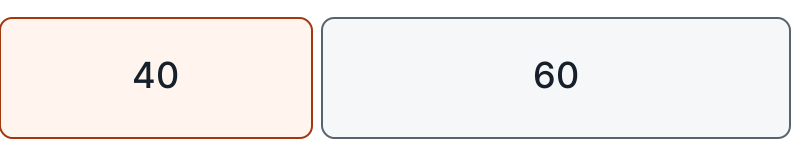
Consider a hypothetical order book, not a live measurement from either platform. You want 100 shares. There are 40 available at 0.50 and another 60 at 0.55. Filling the entire order costs:
40 × 0.50 + 60 × 0.55 = 53.00
The average price is 0.53, not 0.50. Reading only the first quote would suggest a 50.00 cost, understating the before-fee bill by 3.00. This difference can outweigh the platform-fee differences in the table.
One order, two price levels
Cost: 20.0060 shares × 0.55
Cost: 33.00
Both platforms document market and limit orders. HypaForecast also explicitly describes partial fills, open orders and failed execution. A market order seeks available liquidity; a limit sets a price constraint but cannot guarantee a fill. If an order fills at several prices, calculate its fees over the actual fills instead of applying the headline price to every share. H04, P08
Selling is a second transaction—not a withdrawal
A hypothetical HypaForecast trade makes this distinction concrete. Buy 100 shares at 0.50, paying 50.00 + 0.50 entry fee = 50.50 USDC. The following hypothetical outcomes assume the stated full fill and no extra costs. The settlement cases assume the example’s 1-USDC winning payout and no additional settlement charge. H01, H04
| What happens next | Cash or settlement received | Additional trading fee | Net profit / loss versus 50.50 paid |
|---|---|---|---|
| Outcome wins and settles | 100.00 | No additional charge assumed in this example | +49.50 |
| Outcome loses and settles | 0.00 | No additional charge assumed in this example | −50.50 |
| Sell all 100 at 0.60 before resolution | 60.00 gross | 0.60 | +8.90 |
| Sell all 100 at 0.40 before resolution | 40.00 gross | 0.40 | −10.90 |
The sale rows do not promise that 100 shares can actually be sold at those prices. An open position is not yet a withdrawable cash balance. An unfilled order may also reserve funds. HypaForecast’s Terms and Rulebook explain that committed amounts remain restricted until released under the applicable conditions. Polymarket supports early sales too, but execution still requires a valid market and available liquidity. H02, H03, P07, P08
Who decides the outcome?
Choosing a venue also means choosing a resolution process.
Polymarket international uses the UMA Optimistic Oracle. Outcomes are proposed and can be challenged; disputes can lead to further review or voting. That means an event ending and a position becoming finally redeemable are not necessarily the same moment. P09
HypaForecast uses its operator or designated providers to determine outcomes from the Event Rules and stated source data. Its Terms and Rulebook allow delays, cancellations and specified corrections in cases such as source failure, ambiguity or emergencies. It is not presented here as the same decentralized dispute process. H02, H03
For either venue, read the source, observation window, cutoff time and invalid/cancellation treatment. For example, a price-at-deadline question and an average-over-a-window question can resolve differently even when their headlines sound similar. This is a conceptual distinction, not a claim that a particular pair of currently listed contracts uses those two rules. A familiar event title should never substitute for reading the contract.
Withdrawals, language and mobile use
Compare time to usable funds—not a single “instant” label
There are three separate stages: free the balance, process the withdrawal, and receive the destination asset. Add another step when converting that asset into a bank balance.
HypaForecast says available-balance withdrawals normally process immediately or near-immediately. That does not guarantee the time to sell a position, pass a review, receive blockchain confirmations or obtain bank funds. Its Rulebook allows withdrawal conditions, including fees, minimums and compliance checks; this article does not assert that every HypaForecast withdrawal route is free. H01, H03
Polymarket documents supported withdrawal routes and no platform withdrawal fee, while also describing conversion and pool-liquidity constraints. A zero platform fee is not proof of zero bridge, provider or network cost. For either product, compare the quoted destination amount, the supported receiving asset/network and the expected time—not just the debit from the trading balance. P01, P06
Use language support as a practical test
HypaForecast offers 20 locales. That can be useful when reviewing an order and navigating your account in a preferred language, but it is not proof that every market’s wording is equally localized or that the service is available in every country. The English Terms and Rulebook control where their translations conflict. This article does not claim Polymarket is English-only or assign either platform a language-quality score. H01, H02, H03
No comparative mobile task-completion test was conducted. A useful check on your own device is whether you can read the complete rules, see the average-price/fee preview, change order type and find the sell/withdraw controls without confusion. Readability and a familiar login method are useful; neither guarantees a better trade.
Make the final choice
Keep Polymarket when it already offers the contract, custody approach, funding route and full-size execution you need. Its fee-free markets and lower-fee high-price examples are legitimate advantages in the cases described above.
Consider HypaForecast when you are eligible and its actual markets, language experience and Solana-USDC workflow better suit you. Its simple taker-fee formula is useful for planning, but evaluate it alongside company-administered balances, market rules, execution and the full funding/withdrawal route.
Choose neither for that trade when eligibility fails, the contract does not express your intended view, the order cannot be executed acceptably or the funding path remains unclear. Comparing does not require opening or funding a new account.
For your next step, browse HypaForecast markets or review Polymarket’s current markets, then inspect the exact contract and quote that matter to you. Eligibility and market conditions apply; this is a platform comparison, not a recommendation of an outcome or position.
Explore HypaForecast markets
Browse topics that interest you, or open a 5- or 15-minute Bitcoin market to check the question and round rules.
Check eligibility, round rules and current market status before trading.
Questions readers ask
Is HypaForecast cheaper than Polymarket?
Not in every case. On the illustrated 100-share taker trade at 0.50, HypaForecast’s fee is 0.50 versus 1.75 for Polymarket’s 0.07 crypto schedule. At 0.90, HypaForecast is more expensive: 0.90 versus 0.63. Polymarket also lists fee-free markets. Use the exact market’s fee setting and include the execution price and external costs. H01, P01, P02
Do I need a separate crypto wallet to sign up?
Can I withdraw the value shown on an open position immediately?
Can someone in the U.S. choose HypaForecast instead of Polymarket US?
Sources and methodology
This comparison uses the current official documents and the explicitly identified operator confirmations collected for this article. It does not rely on search-result AI summaries as factual authorities. Fee and order-book examples are reproducible calculations, not live quotes. There is no tested liquidity ranking, withdrawal-speed ranking, safety score or overall winner.
The research did not establish a sufficiently comparable first-hand user-experience sample, so no testimonial-based ranking is included. Precise HypaForecast funding-route availability, complete live language-selector behavior, private account flows and actual transaction performance were not independently tested. Country-specific legal advice and Polymarket’s non-event-contract products are outside this comparison.
Supplied by HypaForecast for this comparison, October 1, 2026. Covers fees, trading asset, signup, funding scope, normal withdrawal processing and interface inventory. Not an independent transaction test.
Official primary source; checked October 1, 2026. Source date: 2026-06-17.
Official primary source; checked October 1, 2026. Source date: 2026-06-17.
Official primary source; checked October 1, 2026. Source date: 2026-07-01.