
Contents
- Rollup vs sidechain at a glance
- Why a bridge does not turn a sidechain into a rollup
- Optimistic and ZK rollups: two ways to check the result
- “Confirmed” does not always mean “ready to withdraw”
- Compare the whole trip, not just the transaction fee
- The risks a category label leaves out
- A practical checklist before choosing a network
- Frequently asked questions
- The bottom line
- Sources
A rollup and a sidechain can both let you transact away from Ethereum mainnet. The important difference is how they establish a trustworthy result. An Ethereum rollup publishes the data needed to reconstruct its state on Ethereum and uses Ethereum contracts to enforce its proof or dispute rules. A sidechain uses its own consensus to decide which transactions are valid. Connecting it to Ethereum through a bridge does not give it Ethereum's consensus security. Ethereum scaling overview
For you, that changes the questions worth asking: Who can change the rules? Can you get your funds out if an operator stops? What does “confirmed” mean? Start there, then compare the cost of the route you actually plan to use.
This guide focuses on Ethereum-connected systems. It explains architecture, not which token to buy or which network is universally safest.
Rollup vs sidechain at a glance
| What to compare | Ethereum rollup | Independently secured sidechain |
|---|---|---|
| Where transactions execute | Outside Ethereum mainnet | On a separate blockchain |
| What establishes correctness | A validity-proof or fault-proof system enforced through Ethereum contracts | The sidechain's own consensus rules and participants |
| Where reconstructable state data is available | Published through Ethereum's data-availability mechanism | The sidechain's own data infrastructure |
| Connection to Ethereum | Settlement contracts and an associated bridge | A bridge with its own verification and custody design |
| What to check before an exit | Proof or challenge requirements, withdrawal steps and any extra delay | Sidechain finality plus the particular bridge's release requirements |
| What the label cannot tell you | Actual fees, operator powers, upgrade controls or bridge safety | Actual fees, validator concentration or bridge safety |
The table describes the architectural distinction, not an audit of every deployed network. Ethereum's rollup overview and sidechain documentation explain why execution away from mainnet is not enough to make something an Ethereum L2.
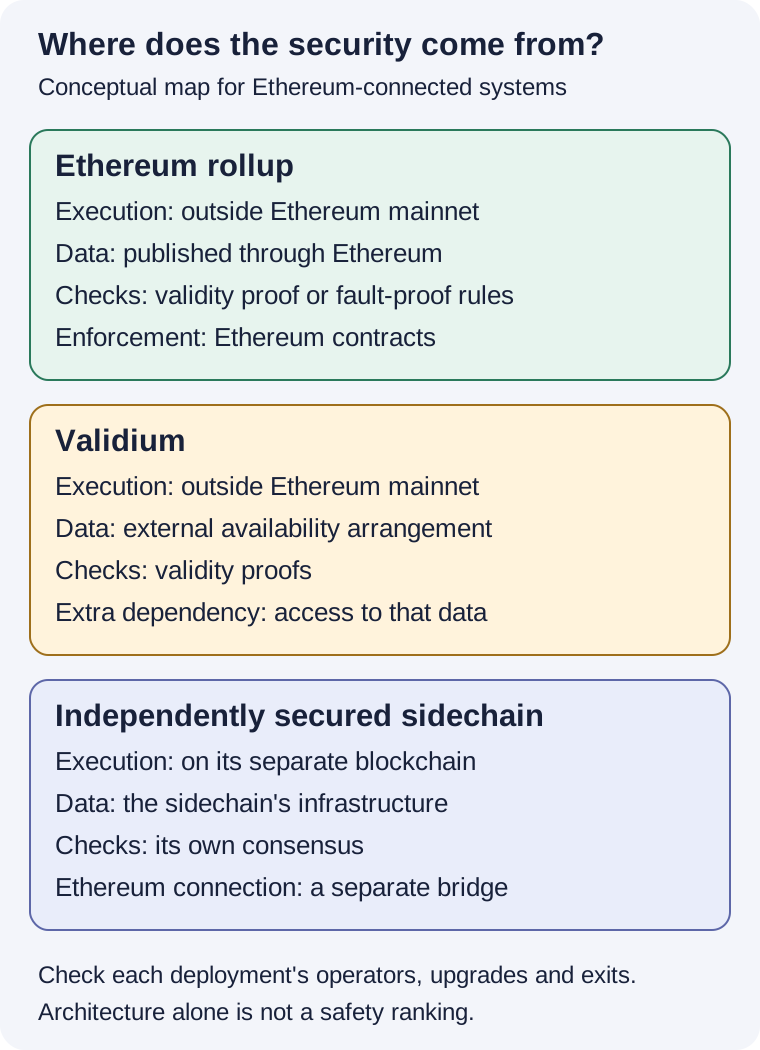
The key questions are separate: who checks the result, and where is the data needed to reconstruct it? A connection to Ethereum answers neither question on its own.
Why a bridge does not turn a sidechain into a rollup
A sidechain can choose its own block-production and consensus rules. Its validators may agree that a transfer is complete without Ethereum validators re-executing or verifying that sidechain's transactions. A bridge connects the two systems, but its contract must still decide what evidence to accept before releasing or representing assets. Ethereum sidechain documentation
For an Ethereum rollup, execution happens elsewhere while relevant data is made available on Ethereum. That data lets the rollup's state be reconstructed rather than leaving users dependent only on an operator's private database. Compression and batching reduce the amount of base-layer work needed per transaction. Vitalik Buterin's rollup explanation
When comparing two networks, ask for the mechanism behind “secured by Ethereum.” Is Ethereum enforcing rules for state transitions, or merely recording a statement from another validator set? Those are different assurances. A familiar wallet, an Ethereum-compatible address or an EVM-compatible application does not resolve that question.
Optimistic and ZK rollups: two ways to check the result
An optimistic rollup allows a proposed state claim to stand unless it is successfully challenged. A fault proof, also called a fraud proof, is the mechanism for demonstrating an incorrect claim. Its security depends on the dispute system working and an honest participant being able to submit a challenge within the required time. Ethereum's optimistic-rollup guide
A validity rollup, commonly called a ZK rollup, supplies a cryptographic proof that a proposed state transition follows the system's rules. The Ethereum verifier checks that proof rather than re-running every transaction. “ZK” does not by itself mean your transactions are private: a rollup still publishes the data needed to reconstruct its state. Ethereum's ZK-rollup guide
Neither proof label establishes that the entire operation is decentralized. For example, the OP Stack's fault-proof documentation describes permissionless proposals and challenges alongside a Guardian backstop. Read the deployed chain's current permissions, not just the name of its proof system. OP Stack fault proofs
A validity proof is not the same as data availability
Data availability concerns whether participants can obtain the data needed to verify or reconstruct what happened. A correct proof and accessible data solve different problems. A compact commitment to data is not a substitute for having the data itself. Ethereum's data-availability guide
A validium illustrates the distinction. It uses validity proofs but keeps the relevant data outside Ethereum's data-availability layer. That adds reliance on the external data-availability arrangement. If the necessary data is withheld, users may be unable to construct the evidence needed to withdraw, even though the validity proof is sound. Check who holds the data and what happens if they stop providing it. Ethereum's validium guide
Do not automatically relabel every validium as a conventional sidechain, either. Proof enforcement, data availability and consensus should each be described explicitly.
“Confirmed” does not always mean “ready to withdraw”
A wallet status can compress several different events into one word. Keep these milestones separate:
- A sequencer, the component ordering transactions, has included your transaction.
- Its data has been published to Ethereum, and the containing Ethereum block has reached finality.
- The relevant state or withdrawal claim has satisfied the protocol's proof and delay requirements.
- The destination transaction has completed and you can use the received asset.
These are a checklist, not a universal sequence with identical timings on every chain. In the standard OP Stack model, transaction ordering can become final through Ethereum before a Standard Bridge withdrawal becomes executable. A fault-proof challenge to a withdrawal claim does not mean that all those L2 transactions are waiting to be reordered. OP Stack transaction finality
Validity proofs avoid an optimistic fraud-challenge window, but they do not make every withdrawal instantaneous. Batching, proof generation, base-layer inclusion and an implementation's security delays can still take time. ZKsync's withdrawal documentation, for example, describes an execution timelock and says finalization also depends on network activity and proof generation. Its delay is a configuration detail, not a universal ZK-rollup rule. ZKsync withdrawal design
What a fast bridge changes
A liquidity-based bridge can pay you on the destination chain before the underlying canonical withdrawal completes. In a simple version, a liquidity provider takes over the pending withdrawal and receives a fee for advancing the funds. You receive usable assets sooner, but the original protocol has not become final sooner. Ethereum's optimistic-rollup exit explanation
Compare that route's fee, available liquidity and contract or operator assumptions with the canonical route. A bridge can introduce its own software, custody and censorship risks. A fast quote is a service offer, not proof of a stronger base protocol. Ethereum bridge risks
Compare the whole trip, not just the transaction fee
There is no permanent rule that a sidechain, optimistic rollup or validity rollup must be cheapest for every activity.
Rollup costs depend on what is executed, how much data is published and how shared costs are allocated. Validity systems also incur proving and verification costs. Batching can spread overhead, but neither a proof label nor a headline throughput figure tells you what your particular transaction will cost. ZK-rollup cost components
Fee formulas also change by implementation and version. For example, OP Mainnet's documentation distinguishes execution, L1 data and, after its Isthmus upgrade, operator fees. That is an OP Mainnet formula, not a formula for every chain. OP Mainnet transaction fees
For a short visit to an application, entry and exit costs may matter more than small differences in transaction fees. For repeated use, the per-transaction component becomes more important. Compare the same activity, asset, amount and exit destination.
Worked example: the cheaper transaction can make a dearer trip
These are invented USD-denominated quotes, not current fees or claims about a named chain. Assume you start on Ethereum, make ten simple transactions, then return to the same asset on Ethereum. Entry and exit figures include all quoted bridge and gas costs for those steps. No swap, application fee or price movement is included.
| Cost in this example | Route A | Route B |
|---|---|---|
| Entry | $2.00 | $3.00 |
| Ten transactions | 10 × $0.04 = $0.40 | 10 × $0.01 = $0.10 |
| Exit | $4.00 | $6.00 |
| Total | $6.40 | $9.10 |
Route B has the cheaper individual transaction, but Route A costs $2.70 less for this trip. That result says nothing about either route's security or waiting time.
With these invented fixed entry and exit costs, the totals are equal at 100 transactions: $6.00 + 100 × $0.04 = $9.00 + 100 × $0.01 = $10.00. Real quotes may change before you exit, so treat this as a way to compare routes, not a forecast.
If your plan includes a swap, add its trading fee and price impact. Do not add a fee twice when it is already included in an all-in bridge quote.
The risks a category label leaves out
Before treating a network as suitable for meaningful funds, look beyond “rollup,” “sidechain” or “ZK.”
- Operator availability and censorship. Who orders transactions, publishes batches or produces proofs? If one of those services stops, what documented fallback lets users proceed? Distinguish a temporary halt from the ability to authorize an invalid transfer.
- Proof and contract correctness. A verifier enforces the rules implemented in its code. Bugs in those rules or surrounding bridge contracts remain relevant. ZKsync explicitly describes its execution delay as a defense against critical bugs, including circuit and sequencer compromise. ZKsync's security rationale
- Admin and upgrade powers. Find out who can replace contracts, pause withdrawals or change security settings. OP Stack documentation lists privileged roles and explains how compromised upgrade authority can threaten bridged funds. That is a concrete example of why proof-system decentralization and administrative control need separate checks. OP Stack privileged roles
- Independent consensus. For a sidechain, assess its actual validator and consensus arrangement. A bridge cannot remove dependence on that chain's own agreement about valid state. Ethereum sidechain documentation
Optimism's own security model also warns that fault proofs do not remove the significance of powerful upgrade controls. “Inherits Ethereum security” should therefore be read as an architectural property with implementation assumptions, not a promise that every rollup has the same risk as holding assets directly on Ethereum. OP Stack security model
A practical checklist before choosing a network
For the exact chain and route you are considering, find answers to these questions:
- What checks state transitions, and where is the required data available?
- Which operators, validator set or committees must keep working honestly?
- Who can upgrade the contracts or pause an exit? Is there a delay or emergency exception?
- What status does your wallet show, and what additional condition does the destination require?
- Can you use the canonical exit if a fast bridge has no liquidity?
- What is the full entry, usage and exit cost for your intended activity?
For a builder, add application compatibility, operational requirements and recovery procedures. For a user, prioritize the exact asset and exit route. The best comparison is between two documented deployments, not two category names.
Frequently asked questions
Are sidechains layer 2?
In the Ethereum security-based terminology used here, an independently secured sidechain is not an Ethereum L2 merely because it runs alongside Ethereum. Some discussions use “L2” more loosely for scaling. Check the actual consensus, proof and data-availability design. Ethereum's terminology note
Does a ZK rollup keep my transactions private?
Not automatically. Validity proofs establish correctness; transaction privacy requires additional design choices. The data needed to reconstruct a rollup's state still has to be available. Ethereum's ZK-rollup guide
Do optimistic rollups always require a seven-day wait?
Do not apply that number to every system or every action. OP Stack documentation distinguishes its Standard Bridge withdrawal delay from L2 transaction finality. Check the current chain, bridge and withdrawal procedure rather than treating a familiar waiting period as a universal rule. OP Stack finality and withdrawal distinction
Is a rollup always safer than a sidechain?
The architectures provide different assurances, but the category alone cannot rank deployed systems. Compare proof enforcement, data availability, independent consensus, upgrade controls and the bridge you will use. An architectural advantage does not erase a contract bug or an administrator's powers.
The bottom line
Rollups use a base chain to enforce their settlement rules and make reconstruction data available; independently secured sidechains use their own consensus. Then the implementation details decide how much that distinction helps you.
Before moving funds, check what can go wrong, how you could exit and what the whole route costs. A quick confirmation or a low transaction fee answers only part of the question.
Keep learning
Explore educational guides. These links do not open trading markets.
Sources
- Ethereum scaling overview
- rollup overview
- sidechain documentation
- Vitalik Buterin's rollup explanation
- Ethereum's optimistic-rollup guide
- Ethereum's ZK-rollup guide
- OP Stack fault proofs
- Ethereum's data-availability guide
- Ethereum's validium guide
- OP Stack transaction finality
- ZKsync withdrawal design
- Ethereum bridge risks
- OP Mainnet transaction fees
- OP Stack privileged roles
- OP Stack security model
Publisher: HypaForecast. This is an educational explanation, not an investment recommendation. Technical source pages were checked on October 22, 2026; deployment settings and fees can change.
Share this guide