
On this page
- What exactly gets cut in half?
- New issuance is a flow; existing supply is a stock
- The schedule is set by block height
- Miner revenue does not necessarily fall by exactly 50%
- Does the halving make Bitcoin’s price rise?
- What to check when you see a halving headline
- Common questions
- Read the rule before the price story
- Sources and scope
A Bitcoin halving cuts the new-bitcoin subsidy available for each block in half. It happens every 210,000 blocks under Bitcoin mainnet’s rules. It does not halve the bitcoins in your wallet, remove half the existing supply or guarantee that the price will rise.
The key is to separate three things: newly issued bitcoin, the transaction fees miners collect and the market value of existing coins. Only the first is directly reduced by the halving rule.
What exactly gets cut in half?
When a miner produces an accepted block, its special first transaction, called the coinbase transaction, can claim a block subsidy plus the fees from transactions in that block. The subsidy is new issuance. Fees come from bitcoins that already exist.
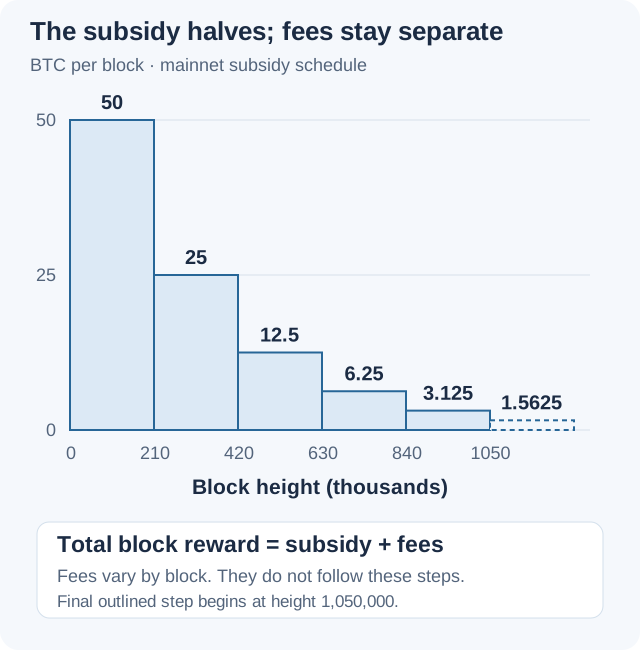
The halving reduces the subsidy component. At block 840,000, the fourth halving reduced it from 6.25 BTC to 3.125 BTC per block. The following threshold is block 1,050,000, when the subsidy becomes 1.5625 BTC. Bitcoin’s halving reference lists the schedule, and Bitcoin Core’s validation code enforces the subsidy-plus-fees limit.
Headlines often call the subsidy the “block reward.” That shorthand can hide a distinction. In this guide, block reward means the combined subsidy and transaction fees; the subsidy is the part subject to halving.
| Item | What the halving changes | What it does not establish |
|---|---|---|
| New-bitcoin subsidy per block | Cuts it in half at the scheduled height | An exact amount issued during each calendar day |
| Transaction fees in a block | No automatic halving rule | A fixed fee level or guaranteed compensation for the smaller subsidy |
| Bitcoins you already hold | No protocol balance reduction caused by the halving | A fixed market value for those coins |
| Existing bitcoin supply | Slows the addition of new coins | Destruction of half the coins already issued |
| Bitcoin’s market price | No price is set by the halving rule | A guaranteed rise, a target price or a reliable trading deadline |
If you hold 0.20 BTC before a halving and make no transactions, the halving itself does not turn that holding into 0.10 BTC. Its value in another currency can still change because the market price can change.
New issuance is a flow; existing supply is a stock
Think of existing supply as the coins already issued and new issuance as the coins being added. A halving slows the addition. It does not reverse earlier issuance.
A simple daily illustration makes the difference concrete. At a ten-minute average interval, there would be 144 blocks in 24 hours:
| Illustrative day with exactly 144 blocks | Subsidy per block | New subsidy across the day |
|---|---|---|
| At the pre-2024 subsidy | 6.25 BTC | 900 BTC |
| At the post-2024 subsidy | 3.125 BTC | 450 BTC |
| At the subsidy beginning at height 1,050,000 | 1.5625 BTC | 225 BTC |
These are arithmetic scenarios, not measured daily issuance. Actual block counts vary, and the figures assume the full permitted subsidy is claimed. Fees are excluded because transferring existing bitcoin as a fee does not create new bitcoin.
In the first transition, 450 fewer new BTC would be added in that illustrative day. It would be wrong to say that total existing bitcoin supply falls by 50%. The percentage applies to the new subsidy per block, not to the stock of all coins.
The schedule is set by block height
A block’s height is its position in the chain, starting with the genesis block at height zero. Bitcoin mainnet uses a 210,000-block subsidy-halving interval. It targets an average of 600 seconds between blocks, so one interval corresponds to about four years, rather than an appointment on a fixed calendar date. Bitcoin Core’s mainnet parameters specify both numbers.
| Event | First block height with the lower subsidy | Subsidy from that height | Calendar context |
|---|---|---|---|
| First halving | 210,000 | 25 BTC | 2012 |
| Second halving | 420,000 | 12.5 BTC | 2016 |
| Third halving | 630,000 | 6.25 BTC | 2020 |
| Fourth halving | 840,000 | 3.125 BTC | 2024 |
| Fifth halving | 1,050,000 | 1.5625 BTC | 2028 is an estimate, not a fixed date |
The original subsidy was 50 BTC. Values in the table describe the subsidy, not the total fee-inclusive reward. The years come from Bitcoin’s halving history; future calendar timing remains an estimate.
Why countdown dates move
A countdown estimates how long it will take to mine the blocks remaining before the threshold. Change the assumed average block interval and the projected date changes, even though the target height does not.
For example, suppose a hypothetical countdown has 10,000 blocks remaining:
- At 10 minutes per block, the simple estimate is 100,000 minutes, or about 69.44 days.
- At 9.5 minutes per block, it is 95,000 minutes, or about 65.97 days.
- At 10.5 minutes per block, it is 105,000 minutes, or about 72.92 days.
This is a sensitivity example, not a current countdown or a forecast. Block discovery varies, and future difficulty adjustments affect the assumptions. When quoting a date, check the observed height, when it was read and how the countdown estimates future block times.
The useful distinction is between a known rule and an estimated arrival time: “at block 1,050,000” identifies the event; “on this exact day” requires a forecast that can change.
Miner revenue does not necessarily fall by exactly 50%
A halving changes one component of a miner’s revenue. It does not fix transaction fees, the price used to value bitcoin or the miner’s expenses.
Consider a hypothetical comparison around the 2024 subsidy change. Hold transaction fees at 0.50 BTC per block on both sides and assume the full subsidy and fees are claimed:
| Component | Before the halving | After the halving |
|---|---|---|
| Subsidy | 6.25 BTC | 3.125 BTC |
| Transaction fees, assumed unchanged | 0.50 BTC | 0.50 BTC |
| Combined block reward | 6.75 BTC | 3.625 BTC |
The subsidy falls by 50%. The combined amount falls by 3.125 BTC, or about 46.30% of 6.75 BTC. In reality, fees need not stay unchanged, so a comparison between two actual blocks could be quite different.
That combined amount is still not net mining profit. Equipment, electricity, operating costs and any pool arrangement matter. A miner’s share of accepted blocks matters too. Converting the BTC revenue to dollars or another currency introduces a price assumption.
Some miners may change their operations when the subsidy falls, but the halving rule does not guarantee who will remain profitable or how total hashing power will change. Difficulty responds through its separate retarget mechanism; it is not automatically cut in half at a subsidy boundary.
Does the halving make Bitcoin’s price rise?
No increase is guaranteed. The schedule tells you how the subsidy changes, not what buyers will pay. Bitcoin’s FAQ describes price in terms of supply and demand and warns against assuming guaranteed returns.
A smaller flow of newly issued coins is not the same as a smaller amount being offered for sale at every price. Existing holders can buy or sell, and miners do not all have to sell newly received coins immediately. Demand can also change. Those choices are not fixed by the subsidy code.
A price chart around past halvings is an observation, not a controlled test showing that the halving caused every subsequent move. The event is known in advance, so a market story also needs to explain what changed relative to expectations and which other conditions mattered.
If someone claims that a halving “must” double the price, ask what evidence supports that extra step. Halving the new issuance per block does not mathematically imply doubling the price of every existing coin.
What to check when you see a halving headline
Use four questions to separate an accurate definition from a forecast:
- What is being halved? Look for the block subsidy, not wallet balances, outstanding supply or necessarily the total reward.
- Which height is the event? An exact block threshold is different from an estimated date.
- Which unit is being compared? BTC per block, BTC per day, a miner’s revenue and a price in another currency are different measurements.
- Where does the certainty stop? A protocol rule does not guarantee fees, profitability, demand or a market return.
A good explanation should let you answer those questions without requiring you to buy bitcoin or choose a mining service.
Common questions
Do I need to move my bitcoin before a halving?
The halving does not require holders to move coins or claim a replacement asset. It changes the subsidy available in new blocks. An invitation to transfer coins or reveal wallet credentials to “receive the halving” is not part of this protocol event.
Are transaction fees halved too?
No. Fees come from the transactions included in a block and are separate from the subsidy. The halving rule does not divide each transaction’s fee by two or guarantee that fees will rise enough to replace the lost subsidy.
Is the next halving exactly four years after the last one?
No. The interval is 210,000 blocks. Roughly four years is a timing description based on average block production, not the trigger. The threshold following block 840,000 is block 1,050,000, commonly estimated to arrive in 2028.
Who receives the new subsidy?
It is available through the coinbase transaction of an accepted block, not distributed automatically to everyone who owns bitcoin. Where miners work through a pool, the pool’s payout arrangement is a separate matter, as the Bitcoin mining guide explains. Holding BTC alone does not entitle you to a portion of each new subsidy.
Does mining stop when the subsidy eventually reaches zero?
Bitcoin calculates the subsidy in whole satoshis, with 100,000,000 satoshis in 1 BTC. Successive integer halvings eventually bring that amount to zero. A zero subsidy does not, by itself, prohibit new blocks: transactions can still offer fees. Whether those fees support a given level of mining activity is an economic question, not a guaranteed outcome of the issuance schedule.
Read the rule before the price story
The essential meaning of a Bitcoin halving is a smaller subsidy per block at a specified height. Keep that rule separate from existing holdings, variable fees and market predictions, and most misleading interpretations become easier to spot.
To explore the surrounding concepts, read how market cap differs from fully diluted valuation, how token vesting cliffs work or why markets can react differently to the same news.
Keep learning
Explore educational guides to understand market concepts and evaluate claims.
Sources and scope
- Bitcoin halving reference: historical thresholds, subsidies and estimated future timing.
- Bitcoin Core v30.0 mainnet parameters: the 210,000-block interval and ten-minute target spacing.
- Bitcoin Core v30.0 validation code: the subsidy calculation and the permitted subsidy-plus-fees amount.
- Bitcoin developer guide: blocks, proof of work, transaction fees and consensus.
- Bitcoin FAQ: supply, demand and the absence of guaranteed financial returns.
This guide explains Bitcoin mainnet’s issuance schedule, not a current countdown, investment recommendation or mining-profit forecast. The v30.0 code citations provide a fixed technical reference; they are not a claim about the latest software release.
HypaForecast publishes educational guides and operates a prediction market. This guide explains Bitcoin mechanics, not an investment recommendation.
Share this guide