
On this page
Kalshi and HypaForecast can suit different ways of trading the same kind of question. Kalshi combines dollar-denominated event contracts, a CFTC-designated exchange and several account-dependent funding routes. HypaForecast combines a Solana-USDC trading balance, email/social/wallet signup, a multilingual interface and a 1% taker fee on executed value. Neither the fee headline nor the presence of a wallet tells you which is the better fit. K01K07H01
Start with the contract you need and how you intend to get money in and out. Then compare the price available for your whole order. Keeping Kalshi is a reasonable choice when its markets, funding route and executable prices already work for you. A move to HypaForecast should solve a concrete problem, not simply replace one logo with another.
Kalshi may fit better when…
You want its exchange structure and eligible dollar-based payment routes, or the particular event contract you need is available there. Its general taker fee can also be lower at high contract prices. [K01][K07]See the fee examples.
The differences that matter first
| Decision | Kalshi | HypaForecast |
|---|---|---|
| Account and trading balance | Identity-verified exchange account; event contracts priced in US dollars. K02K07 | Email, supported social account or wallet signup; positions use USDC on Solana. H01 |
| Getting money in | Bank and other payment routes depend on your account and country; crypto funding is also supported. K03K07K08 | Supported crypto funding can start on multiple assets/chains before reaching the Solana-USDC trading balance. H01 |
| Trading fees | Price-dependent general fee, with market-specific multipliers and maker exceptions. K04K05K06 | 1% of executed value for takers; 0% maker fee. H01 |
| Getting money out | Available cash, route eligibility and deposit holds determine withdrawal options. K09 | Available-balance withdrawals are approved and executed by HypaForecast, in Solana USDC. H02 |
| Placing or exiting an order | Quick/market and limit orders; price and available size matter. K12K13 | Market and limit orders; an early exit still needs executable liquidity. H03 |
| Geographic fit | Available to eligible users in many countries—not US-only. K03 | Eligibility depends on the applicable restrictions; a language option is not country permission. H05 |
Kalshi documents checked 2 October 2026. HypaForecast product information: 2 October; account/funds specifications: 30 September; saved order-support evidence: 1 October. See the source notes for scope.
This is a comparison of prediction/event contracts, not a comparison with perpetual futures. It also does not treat USD and USDC as the same legal asset. Where numbers are compared, the assumptions are stated.
Account access is different from control of funds
Kalshi requires an eligible account, personal information and identity verification. Its signup guidance specifies a minimum age of 18 and document verification when requested; its email/phone guide also describes verification of both contact methods. International access is subject to the Member Agreement and applicable requirements, not a blanket promise that every country or contract is supported. K02K03K16
HypaForecast also has a minimum age of 18. KYC is generally not required at registration, deposit, trading or withdrawal, but this is not a never-KYC commitment. Checks may still be necessary, and requests flagged by fraud-detection rules can be held for review. Consult the eligibility guide and Terms of Service before funding. H02H05
Wallet-optional does not mean self-custodial
HypaForecast lets you start with email or a supported social account rather than bringing an external wallet. However, HypaForecast approves and executes withdrawals after a user requests them. Users do not exercise transfer authority solely through exclusively held keys. Recovery support is available, but account restrictions and review can affect access to outgoing funds. H01H02
Customer funds are kept in wallets separate from company operating funds and are not used for company expenses, lending or investment. That separation does not, by itself, establish a trust, insurance, legal protection in insolvency or an independent custody audit. These distinctions matter more than calling a service “crypto-native.” H02
Kalshi’s CFTC designation is a different institutional arrangement. It should not be read as a guarantee against trading losses or as evidence that every contract is available to every reader. K01K02
Compare the complete funding and withdrawal route
A payment method is useful only when you can use it with your own account. Kalshi’s domestic and international menus differ; HypaForecast’s deposit network and its final trading asset also differ.
| Money path | Kalshi | HypaForecast |
|---|---|---|
| Bank or payment-app funding | US accounts may have ACH and supported payment-app/card routes. International accounts use eligible debit-card, crypto or wire options instead; the international wire minimum is $1,000. K03K07 | Fund the account using a supported cryptocurrency. Check the available assets and networks in the deposit flow. H01 |
| Crypto deposits | Supported crypto credits the account’s cash balance. US flows use Zero Hash for crypto/fiat conversion; international accounts use a different processor. K08 | Supported assets/networks are routed or converted as needed into USDC on Solana for trading. Do not send an asset merely because a bridge supports it somewhere else. H01 |
| Withdrawal destination | US accounts can use supported bank and other routes; international guidance lists debit card and crypto. Crypto withdrawal requires a prior crypto deposit. K03K09K11 | The withdrawal route described here sends USDC on Solana to a Solana-compatible address; it does not send funds directly to a bank account or a different network. H02 |
| Timing to plan around | Buying power and withdrawable cash are different. Deposit holds may apply; bank receipt normally takes a few business days. K09K10 | Available-balance requests are normally processed immediately or near-immediately, but checks or network conditions can delay receipt. This is not a guarantee that an open position can be sold immediately. H01H02 |
What sits outside the trading fee?
Kalshi’s fee schedule lists no Kalshi fee for ACH deposits or withdrawals and a maximum 2% card-deposit fee. Crypto funding can incur processor and blockchain costs. Its crypto-withdrawal help page says no withdrawal fees, while the formal schedule allows possible third-party processor charges: check the final route quote rather than assuming every crypto transfer has zero total cost. K04K08K11
HypaForecast charges no platform deposit, withdrawal or settlement/redemption fee. Users pay variable deposit-network and conversion/bridge costs, without a HypaForecast markup; HypaForecast pays the withdrawal-network fee. External services used to acquire or later convert USDC may impose their own charges. H02
For a trader whose money starts and ends in a bank account, Kalshi’s eligible fiat routes may remove a conversion step. For someone already using supported crypto, HypaForecast’s Solana-USDC balance may be convenient. Wallet-optional signup does not remove crypto funding costs or stablecoin/network exposure. Neither route is automatically the cheaper complete journey.
Fees: use the same size and price, then check the exceptions
The general Kalshi event-contract calculation is:
Kalshi taker fee = round up(M × 0.07 × Q × P × (1 − P))M is the applicable multiplier; the general case is M = 1. Q is contract count and P is the contract price in dollars.
HypaForecast’s taker calculation is:
HypaForecast taker fee = 0.01 × Q × PHere Q is share quantity and P is the executed price in USDC. The fee is 1% of executed trade value, not 1% of the potential payout.
The following hypothetical orders each buy 200 contracts/shares, fully as takers, modeled as one fill at one price. Kalshi uses its general M = 1 single-event schedule, not a combo, a special series or an intermediary’s separate charge. The HypaForecast side uses the 1% rate. The comparison assumes nominal 1 USDC = USD 1 only to make the arithmetic comparable; it does not equate the assets or their risks. Transfer costs, spread, slippage, tax and later sale fees are excluded. K04K05H01
| Price per contract/share | Kalshi fee (USD) | HypaForecast fee (USDC) | Lower fee in this illustration |
|---|---|---|---|
| 0.10 | 1.26 | 0.20 | HypaForecast |
| 0.30 | 2.94 | 0.60 | HypaForecast |
| 0.50 | 3.50 | 1.00 | HypaForecast |
| 0.70 | 2.94 | 1.40 | HypaForecast |
| 0.90 | 1.26 | 1.80 | Kalshi |
At a price of 0.90, HypaForecast costs more in this example. A flat percentage of traded value does not always beat Kalshi’s price-dependent fee.
Why the cheaper fee changes with price
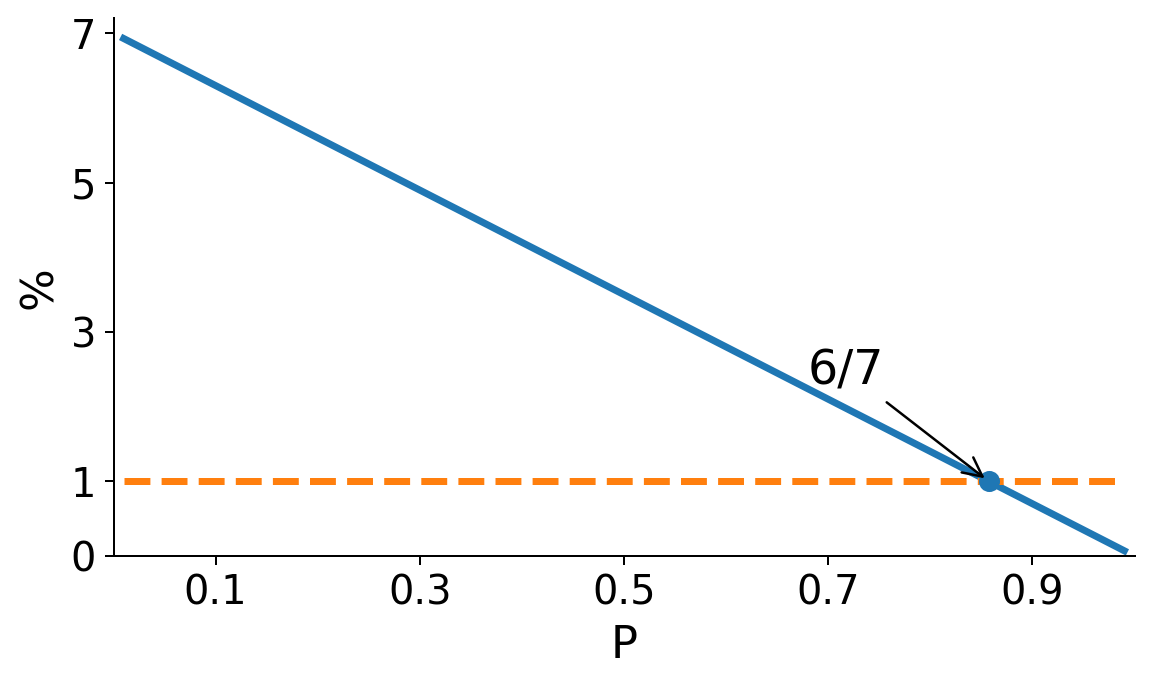
Dividing the unrounded fees by trade value makes the difference easier to see: Kalshi’s general fee is 7% × (1 − P) of that value, while HypaForecast’s is 1%. They meet at P = 6/7, approximately 0.8571. Above that point, the general Kalshi formula is lower; below it, the HypaForecast formula is lower. This is a fee-model boundary, not a live best-execution recommendation.
Precision note: the Kalshi PDF’s rounding description and its worked table use different precision. These five examples already land on exact cents; the figure uses unrounded formulas. For fractional-price or fragmented fills, use the applicable order-ticket charge rather than extrapolating a rounding promise from this table. K04
A limit order is not automatically a free maker order
HypaForecast’s maker rate is 0%. Kalshi has markets with no maker charge and others with designated maker charges; the live schedule also separates combo pricing. An immediately matched limit order can remove liquidity rather than add it. Compare the fee treatment of the actual fill, not just whether you pressed a button labeled “limit.” An unfilled resting order produces no position. H01K05K06K13
A lower entry fee is not the final profit
Consider a separate hypothetical trade: buy 200 at 0.50, with the same full-taker assumptions and nominal USD/USDC parity as above. The purchase value is 100. Kalshi’s entry fee is 3.50 USD, so initial cash paid is 103.50 USD; HypaForecast’s entry fee is 1.00 USDC, so initial cash paid is 101.00 USDC.
| What happens next | Kalshi net result (USD) | HypaForecast net result (USDC) |
|---|---|---|
| The ordinary binary contract/share settles at 1 each | +96.50 | +99.00 |
| It settles at 0 each | −103.50 | −101.00 |
| All 200 are sold at 0.60 as takers | +13.14 | +17.80 |
The sale row deducts both entry and exit fees. Sale proceeds are 120 before an exit fee of 3.36 USD on Kalshi or 1.20 USDC on HypaForecast. The settlement rows assume an ordinary 1-or-0 outcome under the applicable contract rules and no settlement/redemption fee; cancellation or special-resolution terms are not modeled. All other costs remain excluded. These are calculations, not expected returns or promises of an available exit. K04K14H01H02
The full amount paid can be lost. Also, a fee saving can disappear in the execution price: paying an extra 0.02 per unit for 200 units adds 4 to the purchase value before fees. That exceeds the 2.50 entry-fee difference in the 0.50 example. A smaller commission does not rescue a worse whole-order quote.
Execution: compare the order you can fill, not the price you can see
Kalshi documents Quick/market orders and limit orders. Its quick-order guide explicitly explains that larger orders can span price levels; a limit constrains your price but can remain unfilled or fill only partly. HypaForecast also supports market and limit orders, with partial fills and failed execution possible. K12K13H03
Keep the trading terms separate. Volume describes trading activity over a period. The spread is the gap between the best bid and ask. Depth is the quantity available across prices. The executable cost is what your intended size can actually obtain, including fees. Slippage is the difference between the price you expected and the price actually obtained. A busy platform need not have deep liquidity in your particular contract.
This article does not independently benchmark same-market, same-size, same-time executable liquidity. It also does not benchmark withdrawal speed or app performance. Check both entry and exit prices for your intended size; a top-of-book quote alone is insufficient.
For either venue, a sale before resolution depends on the market’s trading state and available liquidity. A limit protects a price condition, not a deadline for cashing out. Until a sale or settlement releases funds, a position is not the same thing as an available withdrawal balance. K09K13H02H03
Contract choice can outweigh platform choice
Kalshi’s documented range includes economics, financial markets, weather and culture, while its market guidance also covers sports and combos. HypaForecast’s public catalog includes crypto, macroeconomic, political, sports and cultural questions. These category labels are useful starting points, not proof that both list the same event or offer the same depth. No comparable live market-count audit is used here. K14K15H04
When an exact Kalshi contract already matches your need, keeping it can be sensible. A contract on a different timeframe or outcome elsewhere is not a substitute simply because both mention Bitcoin, an interest-rate decision or the same team. HypaForecast’s five-minute BTC and 15-minute BTC pages are places to inspect the current question and round—not a claim of identical rules or continuous execution.
Read the named outcome source, observation period and final determination criteria. For sports, check what happens after postponement or cancellation and which part of the game is counted. For an economic release, check which release or revision counts. Kalshi explains that trading close, an event’s apparent end and final settlement need not coincide. Use each HypaForecast question’s current terms and Rulebook rather than importing another market’s price-window rule. K14H05
Language and mobile convenience still matter
HypaForecast’s multilingual interface can help when your preferred reading language is not English. But that does not guarantee that every question has equally detailed localized rules or that every country is supported. Kalshi’s help materials cover both app and website use. Assess the specific surface you rely on: can you comfortably read the rules, full-order price, balance and withdrawal conditions? No comparative usability score is claimed here. H01H05K09
Questions to settle before choosing
Is Kalshi only available in the United States?
No. Its official guidance supports eligible users in many countries, subject to its Member Agreement and restrictions. International funding and withdrawal options are different from US-account options. K03
Is HypaForecast always cheaper than Kalshi?
Can I use HypaForecast without an external wallet?
Does a fast withdrawal mean I can close any position immediately?
Choose around one real use case
For bank-based dollar access, Kalshi’s exchange structure, or a specific contract already working well for you, Kalshi can remain the practical choice. For a supported crypto path, a multilingual interface and a Solana-USDC balance, HypaForecast deserves a look when its actual contracts and executable costs fit. At high prices, include the possibility that Kalshi’s general taker fee is lower.
Neither is the overall winner for everyone. Check eligibility first, and compare the complete money path and intended order rather than deciding from a fee percentage alone.
Still comparing more than two candidates? Read Kalshi alternatives. For another named-platform comparison, see Polymarket vs HypaForecast; the broader Polymarket alternatives guide serves the shortlist decision instead.
Sources and comparison scope
The calculations use the stated formulas, not live matched order tickets. No account opening, identity check, deposit, trade, withdrawal, custody audit or synchronized execution test was performed for this comparison. Third-party user reviews are not used to assign a winner. HypaForecast operating information is first-party; source dates below distinguish current documentation from dated supporting material.
Checked 2 October 2026. Source date: 2020-11-03; designation modification 2025-01-17.
Checked 2 October 2026. Source date: 2026-03-10.
Checked 2 October 2026. Source date: 2026-03-20.
Effective 7 July 2026; checked 2 October 2026. General event-contract formula only in the examples. The fractional-cent precision note and special-series exceptions are material.
Checked 2 October 2026. Standard and combo summaries retrieved; no exhaustive current per-series fee inventory is claimed.
Checked 2 October 2026. Source date: 2026-04-19.
Checked 2 October 2026.
Checked 2 October 2026. Retrieved versions differed on the deposit cap; no fixed cap is used here.
Checked 2 October 2026. Source date: 2026-08-14.
Checked 2 October 2026. Source date: 2026-08-24.
Checked 2 October 2026. Read alongside the fee schedule for any third-party processor charges.
Checked 2 October 2026. Source date: 2026-03-10.
Checked 2 October 2026. Source date: 2026-03-10.
Checked 2 October 2026. Source date: 2026-04-12.
Checked 2 October 2026.
Checked 2 October 2026. Source date: 2026-08-15.
HypaForecast product information dated 2 October 2026: trading asset, signup, funding scope, maker/taker rates, normal withdrawal processing and multilingual support. First-party information, not an independent transaction test.
HypaForecast account, funds and withdrawal operating specifications dated 30 September 2026. These operating details are not an independent custody audit, insurance assessment or evidence that every detail has been incorporated into the public Terms.
Market/limit order support uses dated HypaForecast documentation recorded on 1 October 2026. The guide’s full body could not be rechecked on 2 October; no fresh execution or advanced-order test is claimed.
Public catalog content retrieved 2 October 2026. Examples establish coverage, not an audited market count, matched liquidity or current round availability.
Eligibility-guide summary checked 2 October 2026. Consult the current Terms and Rulebook; no country-specific legal approval or fixed rolling-market rule is asserted.
Share this guide