
Quick answer: which should you shortlist?
For eligible users who want bank-funded event contracts, start with Kalshi and Polymarket US. Both document conventional funding routes and exchange trading. Existing Robinhood users should also check whether their approved account already provides the contracts they want; convenience is useful, but it can carry additional charges. [1], [2], [3], [4], [5]
For eligible users choosing a crypto-funded platform, start with Polymarket international and HypaForecast. Compare the actual questions you want to trade, then the funding and account requirements. Add Limitless when Base USDC and short-duration markets are especially relevant. These are not substitutes for the US products where international services are restricted. [6], [7], [8], [9], [10], [11], [12]
For practice without staking cash on event contracts, start with Manifold’s free mana markets. Mana is not a cash-redeemable trading balance. Optional prize drawings are a separate feature with their own conditions. [13], [14]
There is no universal winner here. A good choice for a US bank-funded account can be a poor choice for someone who already holds supported crypto elsewhere. The table is a starting point, not a ranking.
On this page
Which prediction market platforms should you shortlist?
Use the first column to find your situation, then apply the deciding condition. These are conditional recommendations, not an overall league table. A platform that fails eligibility or cannot offer your intended contract is out before price enters the decision.
| What matters most to you | Keep these candidates | What decides between them | When neither is a fit |
|---|---|---|---|
| An eligible US account funded through a bank | Kalshi; Polymarket US | Choose the one that offers your exact contract and a workable clearance/withdrawal route. If both pass, compare the full-order debit; instant buying power alone does not favor one over the other. [2], [4], [22], [16] | Your state or contract is unsupported, or your money must be withdrawable before the deposit clears. |
| Staying inside an already-approved investing account | Robinhood; the direct exchange offering the contract | Keep Robinhood when its settled balance and available contract save account switching. Choose the eligible direct route when its quote and combined charges are sufficiently better to justify a separate account. [5], [2], [4] | The necessary account is not approved, the balance is unsettled, or the contract is unavailable. |
| Keeping Base USDC in an external wallet you control | Limitless using an external wallet; compare another crypto venue only if you accept its different balance model | Start with the Limitless external-wallet route for this specific custody preference. Do not treat its social-login wallet as interchangeable: the key-export and withdrawal arrangements differ. [36], [11] | You are ineligible or the desired contract is missing. A wallet preference does not override either condition. |
| Using a localized interface with a Solana-USDC trading balance | HypaForecast; Polymarket international as the alternative | Start with HypaForecast when its language and balance model meet a real need. Keep Polymarket international when its actual contract or full-cost quote fits better and you accept its Polygon pUSD collateral. [9], [32], [7], [8] | Your location is restricted, the funding route fails, or neither offers the question and rules you need. |
| Following events with crypto, without a fixed chain preference | Polymarket international; HypaForecast | Look for the precise question first, then use the acceptable funding/withdrawal route as the tiebreaker. Add Limitless only for a relevant contract or a Base workflow—not to make the list longer. [6], [7], [9], [17], [12] | Neither offers the required event or a usable way to move funds in and out. |
| Learning without staking cash on event contracts | Manifold’s free mana markets; the trading guide | Choose practice rather than a funded venue until you can explain the losing condition, costs and exit. Mana is not a cash-redeemable balance. [13], [14] | You specifically need a cash-redeemable contract; that is a different decision. |
For a full feature-by-feature table, use our prediction market comparison. Here, the aim is to remove unsuitable candidates and make the remaining choice explicit.
How we make the recommendations
We assess seven products separately: Kalshi, Polymarket US, Polymarket international, HypaForecast, Limitless, Robinhood event contracts and Manifold. Inclusion requires a useful role in the decision and enough official or first-party information to explain the relevant trade-offs. This is a selective shortlist, not a directory of every active platform.
Our selection process uses three filters, in this order:
Can you use it?
Check eligibility, transaction permissions and a workable funding and withdrawal route. Failure here removes the platform from your shortlist.
Does it fit your trade?
Match the question, contract rules, order controls, asset and interface to what you actually need.
Is the quote acceptable?
Compare entry and likely exit costs at your intended size. A lower headline fee does not override a worse executable price.
We do not assign points to criteria that have not been measured. We have not conducted a simultaneous, same-market, same-size execution benchmark, a comparative mobile usability study, or timed live deposit and withdrawal tests. Consequently, we name no liquidity, safety, payout-speed or overall champion. Recommendations below are editorial judgments from the documented product features, not promises of performance.
HypaForecast publishes this guide and is included in the shortlist. Its fee can be higher than a competitor’s, its eligibility rules exclude some readers, and its interface language count does not prove deeper markets. The same choose-or-skip test applies to it.
Check the app and the exchange before you choose
A familiar app can be a convenient way to reach a contract without being a different exchange. Robinhood offers event contracts through its derivatives business and partner exchanges, and the exchange determines settlement under the contract terms. Keep the app, the venue and the individual contract separate when comparing candidates. [5], [43]
Make sure your chosen device supports the trade
Being able to view a price is not the same as being able to place an order. Robinhood’s trading guide describes event-contract trading in its mobile app, web access for viewing only, and no event-contract access on Robinhood Legend. That makes it a poor fit for a browser-only trading requirement under the documented setup—even when the account and contract otherwise fit. [42]
For any candidate, check that you can read the complete rules and fees, select the intended order and quantity, and find the position-closing controls on the device you plan to use. Compare the final order preview, not just the app-store description. These are selection checks, not a claim that one app has the best mobile usability.
When to choose each platform—and when not to
Kalshi: start here for a dedicated exchange with conventional funding
Choose it when you are eligible, want a dedicated event-contract venue and prefer documented bank or other conventional funding. Kalshi also accepts users in many countries outside the US, but the international routes are different: do not assume US ACH access applies to an overseas account. Identity and residence verification form part of onboarding. [1], [2]
Its limit-order tools are useful when you want price control rather than accepting whatever is immediately available. A resting order still needs a counterparty; it is not a promise that you will enter or exit. The market’s own rules determine its outcome. [15], [19]
Choose something else when your required contract or region is unsupported, or its full-size price and fee are worse for your trade. Kalshi’s default taker formula is price-dependent, and some markets have fee multipliers or maker charges. “Limit order” does not automatically mean “free trade.” [20]
Your next comparison: Polymarket US for another eligible US exchange route; Robinhood when staying in an existing approved account matters more than having a separate interface. A reader outside the US should check Kalshi’s international conditions rather than treating it as US-only. [1], [21], [5]
Polymarket US: a separate US shortlist option, not the international site
Choose it when you are an eligible US user seeking event contracts with documented bank, card or other supported payment methods. Its onboarding uses Google or Apple sign-in followed by identity verification. KYC must be completed before depositing or trading; some users may need an ID and selfie review. [21], [3], [4]
Market and limit orders are documented for the app and web. A limit can partially fill, while a market order is subject to available liquidity and price protection. Neither guarantees the entire amount at the headline price. [16]
Choose something else when your desired contract is not offered in this product, the account is ineligible, or you need to withdraw funds that have not cleared. Instant buying power is not immediately withdrawable cash: deposits commonly take 3–4 business days to clear, and verification can add delays. Withdrawal routing follows the relevant funding requirements. [4], [22], [23]
Your next comparison: Kalshi for the same eligible US use case. Do not import Polymarket international’s collateral, fee exemptions or market catalog into this decision. Polymarket US has its own fee schedule, exchange rules and clearing process. [24], [21], [25], [26], [7]
Polymarket international: consider it for crypto-funded event selection
Choose it when you are eligible for the international product and its actual event selection matches what you follow—such as politics, crypto, finance or world events. This is distinct from the US exchange. Its current trading collateral is pUSD on Polygon, backed by USDC; supported deposits are converted into the trading balance. The deposit asset, collateral and fee denomination are not interchangeable labels. [6], [7], [8], [27]
Email, Google and wallet sign-up routes are documented, so bringing a separate external wallet is not the only entry path. For transactions, follow the precise token, network and address shown in your funding or withdrawal flow. [28], [27], [29]
Choose something else when your jurisdiction is restricted, a supported funding route is inconvenient, or the market’s oracle and dispute process does not fit your expectations. Similar-sounding event titles on two venues can have different resolution criteria. [8], [30]
Your next comparison: HypaForecast where language and its Solana-USDC trading model matter, or Limitless where Base collateral and short-duration markets fit better. Polymarket international’s category-dependent fees also mean that “Polymarket is free” is not a reliable blanket rule. [9], [12], [31]
HypaForecast: consider it when localization and its crypto workflow fit
Choose it when you are eligible, want one of its 20 interface locales and are comfortable taking positions in USDC on Solana. Funding may originate from several supported crypto assets or chains, but the final position asset remains Solana USDC. HypaForecast charges a price-dependent trading fee and 0% CLOB maker fee; network, conversion and provider costs are separate. [9] Fee method
Account creation can start with email, a supported social account or a wallet. A separate external wallet is not inherently required. However, wallet-only sign-in is not enough to transact: the account must also have a verified email, Google or Telegram sign-in identity and a linked wallet. Additional identity or compliance checks may be required before deposits, trading, settlement or withdrawals. [9], [32], [33]
Market and limit orders appear in the trading guide, but availability and execution depend on the market and account. Withdrawals depend on available funds, minimums, fees, account checks, supported networks and operational conditions. Committed funds may remain restricted until released. Processing, sending and destination receipt are separate stages; no immediate-receipt time is guaranteed. HypaForecast processes withdrawals, and balances should not be treated as insured bank deposits or proof of user-only transfer control. [9], [10], [34], [35] Withdrawal conditions
Choose something else when you need a verified direct bank-funding route, are covered by a restricted-jurisdiction rule, or obtain a better executable quote elsewhere. HypaForecast is not a US trading option under its published eligibility rules. Its documentation and terms—not a translated interface or an accessible website—determine eligibility. [10], [32]
Your next comparison: an eligible bank-funded exchange when fiat access is non-negotiable; Polymarket international or Limitless for a crypto-based alternative. The conditional fee examples below do not establish an overall winner; fee-free schedules, actual execution and external costs still matter. No evidence here establishes HypaForecast as the liquidity leader.
Limitless: consider it for Base USDC and short-duration market formats
Choose it when you are eligible, already understand Base funding and want its supported short-duration or other market formats. Limitless uses USDC collateral on Base. External-wallet and social-login wallet options have different signing and gas arrangements; smart-wallet trading can use platform-sponsored gas. [36], [11], [12]
The distinction matters beyond sign-up. An external wallet holds its own USDC and sends it using its wallet interface. A managed wallet uses the platform’s withdrawal flow. The current wallet guide describes restrictions on exporting embedded-wallet keys, so do not assume every login path offers identical control. [36]
Choose something else when your network, account controls or required jurisdiction do not fit. Limitless does not make US trading available under its current terms. Its CLOB taker buy fees are charged in outcome tokens, while sell fees are charged in USDC; makers and AMM trades have different treatment. Comparing the displayed percentages directly with a fee on trade value can mislead. [37], [11]
Your next comparison: HypaForecast or Polymarket international where eligible, using the exact question and resolution window. Limitless’s oracle, timing and cancellation conditions vary by market, and a displayed resolved state is not necessarily the same moment that an on-chain payout becomes redeemable. [18]
Robinhood event contracts: consider the convenience, then price it
Choose it when you already use Robinhood, are an eligible US resident and obtain the required derivatives-account approval. Event contracts operate through its exchange relationships; a familiar front end is not automatically a new, independent pool of liquidity. Its event-contract buying power depends on settled cash, not instant deposits. [5], [38]
Choose something else when you need browser-based event trading under the documented mobile-app-only setup, opening or maintaining the wider account adds friction, the desired contract is unavailable, or the combined costs outweigh the convenience. Commission and exchange charges are separate, and opening and closing can both incur costs. Subscription-dependent pricing should be considered alongside the subscription’s cost—not as a free discount. [5], [42]
Your next comparison: the relevant direct exchange’s eligible product and actual quote. Closing a contract, settlement and withdrawing cash from the account are separate stages; do not judge this route solely by how quickly the buy button becomes available. [39], [40]
Manifold: the practice option, not a cash-trading replacement
Choose it when you want to practise forecasting with free mana and explore user-created questions. Mana cannot be redeemed for cash. Market creators and the platform’s moderation rules matter to resolution, so read the question carefully even when no cash is staked. [13]
Choose something else when your objective is a cash-redeemable event-contract position. Manifold’s optional prize drawings do not turn mana trades into dollar-denominated exchange contracts. Practising here also does not establish how your order would fill on another venue. [13], [14]
Your next comparison: after learning the mechanics, return to the eligible funded-product shortlist rather than treating a successful play-money forecast as proof of trading returns. Our how to trade prediction markets guide explains the next set of decisions.
A lower headline fee can still be the wrong reason to choose
Compare 200 contracts bought at three hypothetical prices under explicitly stated fee assumptions. Each is a standard $1-equivalent binary contract and one full taker fill under the listed schedule. These are not live quotes or evidence that identical contracts are available on all four products.
For HypaForecast, F = 0.02 × ∫[0, C] p(x)(1 − p(x)) dx, where p(x) is the contract’s raw price divided by the sum of all outcome raw prices along the trade. This normalized price can differ from the displayed or raw execution price. Buying adds the fee to the AMM cost; selling deducts it from the gross proceeds. The coefficient 0.02 is not a flat 2% charge on trade value. Fee method
For each HypaForecast row, let C = 200 contracts and hold the normalized fee price and raw payment price equal to the stated p throughout the full taker fill. Assume no overround or price movement. Only then does its fee reduce to 0.02 × C × p × (1 − p). A real AMM quote integrates the changing price path; the initial displayed price alone is insufficient. External costs are excluded, not confirmed zero. Fee method
USD/USDC parity is assumed only to compare these formulas; no conversion or execution is being quoted.
Competitor fee schedules checked 7 October 2026; HypaForecast fee method separately confirmed 26 October 2026. Kalshi uses its default taker multiplier here. Polymarket US uses the standard straight-contract schedule, not table-tennis or combo exceptions. Polymarket international uses the crypto-category coefficient. Fee method, [20], [24], [31]
| Price per contract (USD-equivalent) | Trade value, before fees (USD-equivalent) | HypaForecast fee (USDC) | Kalshi default fee (USD) | Polymarket US standard fee (USD) | Polymarket international crypto fee (USDC) |
|---|---|---|---|---|---|
| 0.10 | 20.00 | 0.36 | 1.26 | 1.25 | 1.26 |
| 0.50 | 100.00 | 1.00 | 3.50 | 3.48 | 3.50 |
| 0.90 | 180.00 | 0.36 | 1.26 | 1.25 | 1.26 |
Under these constant-price assumptions, HypaForecast’s fees are 0.36, 1.00 and 0.36 USDC at p = 0.10, 0.50 and 0.90. All three are below the listed charged schedules, including the dated Kalshi default example of 1.26 USD at 0.90. A fee-free Polymarket international market can have a lower platform trading fee. Actual execution and funding costs can change the total; this is not an overall ranking. Fee method
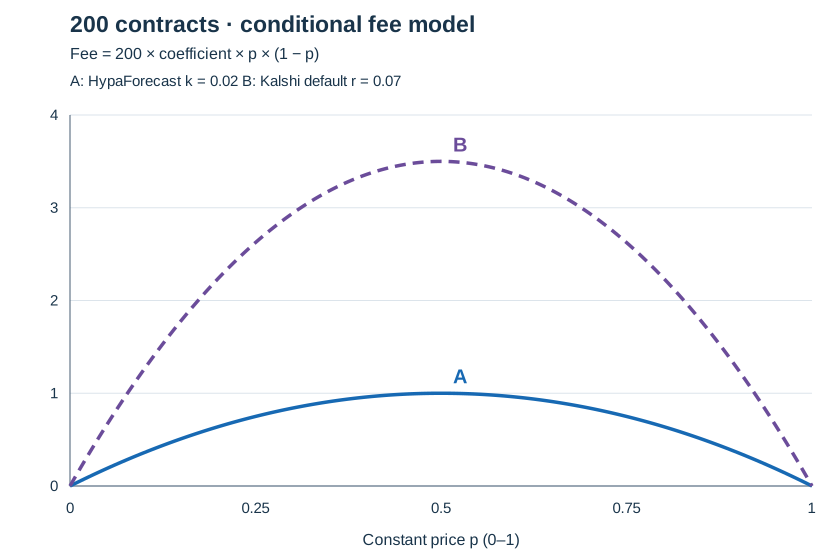
For quantity C and price p, the formulas used are:
HypaForecast’s CLOB maker fee remains 0%. An AMM limit fill uses the AMM fee method; submitting a limit instruction does not automatically make it free. Fee method
- HypaForecast: 0.02 × ∫[0, C] p(x)(1 − p(x)) dx, with normalized p(x) as defined above. Fee method
- Kalshi default taker: 0.07 × C × p × (1 − p), before applicable rounding.
- Polymarket US standard taker: 0.0695 × C × p × (1 − p), rounded to the nearest cent using round-half-to-even.
- Polymarket international crypto: 0.07 × C × p × (1 − p), using its published USDC fee rounding. Fee method, [20], [24], [31]
The illustration treats 1 USD and 1 USDC as equal solely for comparison. It does not establish conversion at parity, eliminate stablecoin risk or represent an all-in cost. It excludes spread, slippage, a later exit, funding, withdrawal, network and provider costs, rebates and promotions. Market-specific multipliers or schedules override the defaults. A limit order can take liquidity for the portion that executes immediately against the book. Any unfilled portion left resting can later provide liquidity as a maker. [20], [24], [31], [16]
Limitless is intentionally outside this normalized table because its buy fee can reduce outcome tokens rather than add an equivalent cash fee. Robinhood requires the applicable commission, exchange fee and subscription context. For either, compare the final quantity received and total debit on the ticket rather than forcing unlike fee bases into this example. [37], [5]
For entry, exit and funding costs beyond this example, use the prediction market fees guide. The point here is to choose between eligible candidates, not to treat one fee table as an overall ranking.
Turn two plausible platforms into one workable choice
Write down one non-negotiable requirement: a bank-funding route, control of your wallet, a particular interface language, or the exact event you follow. Remove candidates that cannot satisfy it. Do not compensate for a failed requirement with a cheaper fee or a familiar brand.
For the remaining two, inspect the complete order and the rule that decides the outcome. Your intended quantity may not fit at the top price; a limit protects price but cannot create a counterparty. Compare the same event, cutoff and resolution condition rather than similar titles. [16], [15], [25], [30], [18], [34]
Finally, identify how the balance becomes usable outside the platform. A sale, deposit clearance, withdrawal processing and final receipt are separate stages. If that route is unclear, keep the decision open rather than depositing to find out. [22], [23], [36], [9], [34]
The detailed comparison guide covers execution, costs and withdrawal checks. The examples below show how to act on those checks.
Four choices with a clear deciding condition
US bank funding: let the actual quote break a genuine tie
Assume you are eligible for both Kalshi and Polymarket US, both offer the contract you want, and both funding routes meet your needs. Neither wins simply because it appears first in this guide. At the same hypothetical price of 0.50 for 200 contracts, the table above gives purchase totals of 103.50 USD on Kalshi and 103.48 USD on Polymarket US, including only the illustrated entry fee. The difference is just 0.02 USD. [20], [24]
Now suppose Kalshi still offers the full 200 at 0.50, but Polymarket US offers them at 0.51. Using the same standard schedules, the totals become 103.50 USD and 105.47 USD, respectively. In that hypothetical choice, Kalshi costs less despite the slightly higher fee coefficient. This is a worked example, not an observed quote; it excludes funding, a later exit and other costs. If the contract rules or usable quantities differ, the example no longer compares like with like. [20], [24], [16]
Existing Robinhood account: convenience must survive the cost check
Suppose your Robinhood Derivatives account is already approved, you have settled cash and the desired contract is available. Keep Robinhood and the relevant direct exchange as your two candidates. Choose Robinhood when staying in that account matters more to you than the quoted cost difference. Choose the eligible direct exchange when its total quote is better and a separate account is acceptable. Remove Robinhood from the immediate shortlist if you are relying on instant deposits rather than settled event-contract buying power. [5], [38]
Crypto funding: choose the balance and control you actually need
If keeping Base USDC in your own external wallet is non-negotiable, begin with Limitless’s external-wallet route, subject to eligibility and contract availability. HypaForecast’s Solana-USDC balance and Polymarket international’s Polygon pUSD balance do not meet that exact requirement. Limitless’s social-login route has different key-control arrangements, so it is not a substitute for the external-wallet route in this example. [36], [11], [9], [7]
If instead a localized interface and Solana-USDC positions are useful to you, begin with HypaForecast and compare Polymarket international only if you accept its different collateral model. Choose the latter when it offers a better-fitting question or a better total quote; choose HypaForecast when its language and workflow solve your need without an unacceptable price trade-off. With neither preference, do not favor a chain: let the actual contract, rules and full funding-and-exit route decide. [9], [32], [6], [7], [8]
Unclear funding or settlement: choose practice, not a deposit
If you cannot explain how a position loses, how its result is decided, or how you would receive usable funds, choose Manifold’s free mana markets and the trading guide first. Do not use a successful play-money forecast as proof that a cash-funded order will execute or earn a return. Return to the funded shortlist once the missing requirement is understood. [13], [14]
For a location-specific question, use the Africa availability guide or Nigeria availability guide, then check current platform terms. Access policy is not a legal conclusion about your circumstances.
Frequently asked questions
Which prediction market is best overall?
No single overall winner is established by this comparison. The practical answer starts with your eligibility and funding route, then narrows to the actual contract and full-size quote. A recommendation that ignores a failed eligibility check is not useful, regardless of its score.
Am I choosing a platform or an individual market?
A platform is the service or access route you use; an individual market is the question and contract you trade there. Use this guide to choose a service, then check the exact contract’s rules and price. It does not rank today’s trades or software companies that build exchanges.
Which prediction market platform is best for beginners?
For practice without staking cash, start with Manifold’s free mana markets and the trading guide. Mana cannot be redeemed for cash. [13] For a funded account, compare only products you are eligible to use, then choose contract rules and a funding-and-withdrawal route you understand. Be able to explain the losing condition before funding.
Do all prediction markets require an external wallet?
No. The US exchange and brokerage routes described here do not require bringing a separate crypto wallet for ordinary bank funding. Polymarket international, HypaForecast and Limitless also document non-wallet-first account routes, though their transaction requirements differ. On HypaForecast, remember the additional verified sign-in requirement for wallet-first accounts. [4], [2], [5], [28], [9], [32], [36]
Which platform has the lowest fees?
Fees depend on the market, order role, actual execution and funding route. Under the constant-price assumptions above, HypaForecast’s modeled fee is lower in all three charged-schedule examples, including 0.90. Fee-free schedules and excluded external costs can change the result. Compare the total cost and quantity received rather than inferring an overall winner from this table. Fee method
Which is best for sports, crypto or politics?
Start with the eligible shortlist, then check the precise event and rules. A venue’s category label does not establish availability of your chosen contract, better pricing or a superior exit. Two sports or crypto markets with different settlement conditions are not identical trades.
Can I sell before the result is known?
Several products here support early exits, but a documented sell function does not guarantee a willing counterparty or the displayed price for your whole position. Check the order book, market state and applicable restrictions. [16], [15], [41], [34], [39]
Does choosing a well-known platform guarantee a profit?
No. A correct forecast can still be a poor purchase at an unfavorable price, and costs reduce returns. Funded event positions can lose the committed amount. Choose the platform to make an informed decision, not to turn uncertainty into a promised payout.
Your next step
Pick one priority and two eligible candidates. Compare one relevant contract, a realistic order size and a usable funding-and-withdrawal route. Keep the platform whose trade-offs you understand; reject the one that fails a non-negotiable requirement.
For a named-platform replacement, continue with Polymarket alternatives or Kalshi alternatives. For the full side-by-side breakdown, return to the comparison guide rather than adding more candidates indefinitely.
Explore HypaForecast markets
Browse the market list, or inspect the question and current round details for the 5-minute and 15-minute BTC markets. Check eligibility and the market rules before taking a position.
Sources and evidence dates
The links below identify the product documentation and first-party information used for the recommendations. Fee and eligibility pages can change; check the applicable current schedule, terms and order preview before transacting. The calculations above are hypothetical, and live transactions were not tested.
- Kalshi international eligibilityChecked 7 October 2026. Source effective/update date: 2026-03-20.
- Kalshi Transfers FAQChecked 7 October 2026. Source effective/update date: 2026-06-18.
- Polymarket US account creationChecked 7 October 2026.
- Polymarket US fundingChecked 7 October 2026.
- Robinhood event-contract overviewChecked 7 October 2026.
- Polymarket fee and category pageChecked 7 October 2026.
- Polymarket exchange upgrade, April 28Checked 7 October 2026. Source effective/update date: 2026-04-28.
- Polymarket Geographic RestrictionsChecked 7 October 2026.
- HypaForecast product information: fees, trading asset, funding and interface localesFirst-party product specifications, 7 October 2026; not an independent transaction or language-usability benchmark.
- HypaForecast Terms of ServiceDocumentation evidence dated 2026-10-07. Source effective/update date: 2026-06-17.
- Limitless Terms of ServiceChecked 7 October 2026. Source effective/update date: 2026-09-15. Current terms control geographical eligibility.
- What is Limitless?Checked 7 October 2026.
- Manifold FAQChecked 7 October 2026.
- Manifold prize drawing FAQChecked 7 October 2026.
- Kalshi Limit OrdersDocumentation evidence dated 2026-10-07.
- Polymarket US order typesChecked 7 October 2026.
- HypaForecast public market catalogDocumentation evidence dated 2026-10-01.
- Limitless Market ResolutionChecked 7 October 2026.
- Kalshi Market FAQsDocumentation evidence dated 2026-10-07. Source effective/update date: 2026-04-12.
- Kalshi event-contract fee scheduleChecked 7 October 2026. Source effective/update date: 2026-07-07. Default taker multiplier only in the example; market multipliers and maker-fee exceptions can apply.
- Polymarket US Trust and SafetyChecked 7 October 2026.
- Polymarket US withdrawal clearanceChecked 7 October 2026.
- Polymarket US withdrawal troubleshootingChecked 7 October 2026.
- Polymarket US standard trading feesChecked 7 October 2026. Source effective/update date: 2026-10-01. Standard straight-contract schedule; market exceptions and rebates are separate.
- Polymarket US Market ResolutionDocumentation evidence dated 2026-10-07.
- Polymarket US Market SettlementDocumentation evidence dated 2026-10-07.
- Polymarket How to DepositChecked 7 October 2026. Source effective/update date: 2026-06-08.
- Polymarket How to Sign-UpChecked 7 October 2026. Source effective/update date: 2026-01-12.
- Polymarket How to WithdrawChecked 7 October 2026. Source effective/update date: 2026-01-12.
- Polymarket resolution and disputesChecked 7 October 2026.
- Polymarket international trading feesChecked 7 October 2026. Source effective/update date: 2026-07-10.
- HypaForecast eligibility and transaction requirementsChecked 7 October 2026. Sign-in and account requirements are distinct from conditional documentary verification.
- HypaForecast account creation and sign-inDocumentation evidence dated 2026-10-07.
- HypaForecast Rulebook v1.4.0Documentation evidence dated 2026-10-01. Source effective/update date: 2026-06-17.
- How to make your first tradeDocumentation evidence dated 2026-10-01.
- Limitless Wallet TypesChecked 7 October 2026.
- Limitless FeesChecked 7 October 2026.
- Robinhood event-contract buying powerDocumentation evidence dated 2026-10-07.
- Robinhood canceling and closing event contractsDocumentation evidence dated 2026-10-07.
- Robinhood event-contract settlementDocumentation evidence dated 2026-10-07.
- Polymarket Place OrdersChecked 7 October 2026.
- Robinhood trading event contracts: app and web accessDocumentation retrieved 10 October 2026. The guide describes mobile-app trading, view-only web access and no access on Legend. Live account and device behavior were not tested.
- Robinhood contract terms and exchange settlementDocumentation retrieved 10 October 2026. Used for the distinction between the app, the exchange and contract-specific settlement authority.
- On 26 October 2026, the operator confirmed the supplied code is deployed and all current markets use coefficient 0.02; maker 0% was separately confirmed unchanged. Code review normalizes the target raw price by the sum across outcomes and integrates p(1−p) along the trade. The coefficient is not a flat 2% charge. These dated operator/code records are not an independent live trade test.
- Terms and Rulebook v1.4.0 dated 17 June 2026 were saved 26 October 2026. Rulebook 6.2–6.3 distinguish restricted commitments from available funds and apply minimums, fees, checks, network and operational conditions. Earlier near-immediate wording is not reconfirmed as a current SLA; that does not establish that the historical statement was false. Rulebook · Terms
Share this guide