
On this page
Quick answer: what do prediction markets charge?
There is no single fee percentage that applies across all prediction markets. Platforms may charge per executed order, set different maker and taker fees, calculate fees from the contract price, or vary charges by market category. You may also pay to fund, convert, or withdraw money. The bid–ask spread and slippage change your execution price even when an exchange charges no explicit trading fee.
First calculate the entry cost: the actual executed purchase amount plus entry fees. Then calculate the sale proceeds after exit fees, or the outcome payout after any applicable settlement charge. Net profit or loss is that receipt minus the entry cost and any applicable external funding or cash-out costs. A $1 winning payout is not the same as $1 in profit. A losing position can lose the amount paid plus entry fees.
The useful comparison is net profit or loss on an equivalent trade, not the headline fee percentage. Fees alone cannot tell you whether you can access a platform or whether its market has enough available liquidity.
Where the cost appears
Costs can arise at different points between funding and withdrawal, though not every cost applies to every trade.
| Cost | When it matters | How to treat it |
|---|---|---|
| Trading / execution fee | A buy or sale is filled | Explicit platform charge; check the fee base and order side. |
| Maker fee or rebate | A resting order adds liquidity and later fills | A maker might pay zero, pay a fee, or receive an incentive; verify the exact market. |
| Taker fee | An order consumes resting liquidity | Often an explicit charge at execution. |
| Bid–ask spread | Buying at the ask or selling at the bid | The gap between quoted bid and ask; not itself an extra billed platform fee. |
| Slippage / price impact | Your full order fills at worse levels than the first displayed quote | Already reflected in the actual average fill price. Do not charge it again in the P&L formula. |
| Funding / on-ramp | Depositing through a bank, card, provider or asset bridge | May be charged by a platform or third party. |
| Conversion / network | Moving between fiat/crypto, assets or chains | Includes conversion spreads, swaps, network/gas and provider quotes when applicable. |
| Withdrawal / off-ramp | Moving available funds out | Platform and provider charges must be checked separately. |
| Settlement / other | A specific venue, instrument or process charges one | Do not assume one exists; some published schedules state none. |
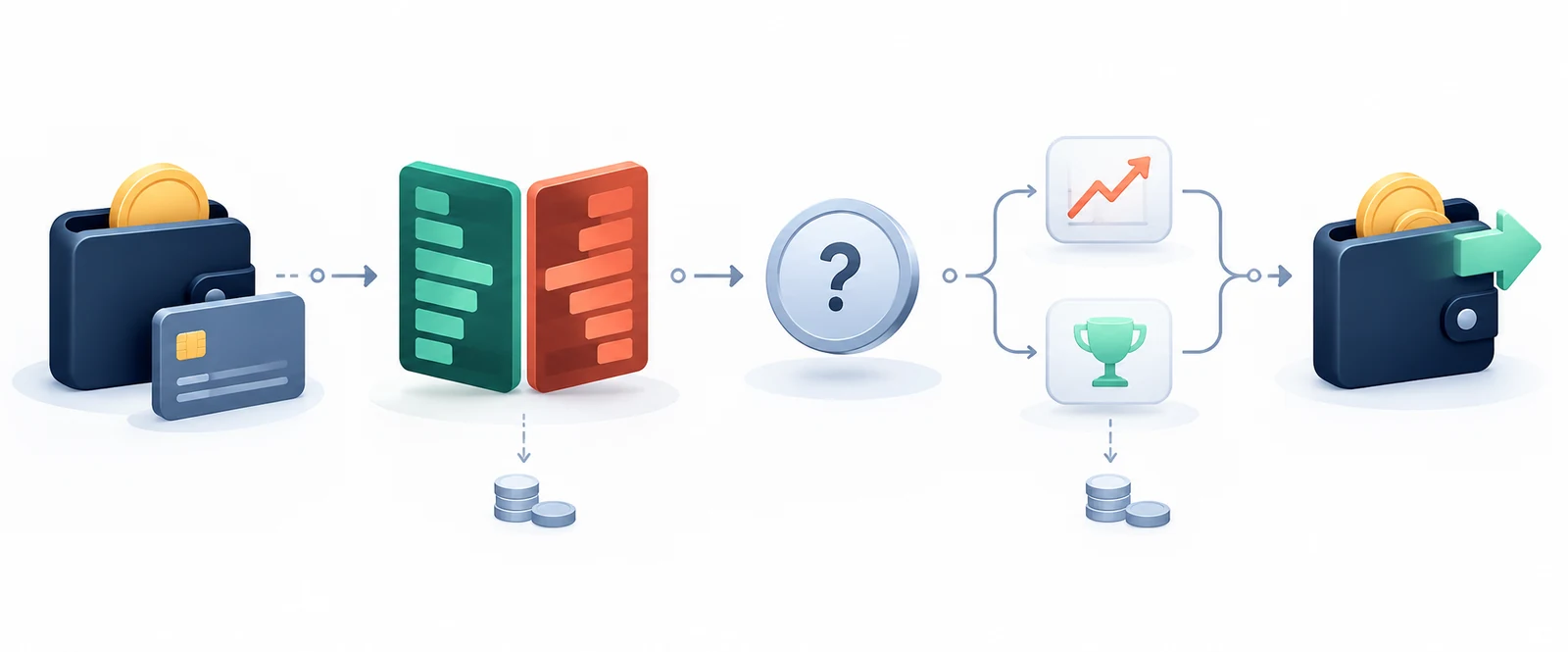
- Fund: Check deposit and conversion quotes.
- Execute: Check maker/taker status, total filled amount and explicit fees.
- Hold or exit: A sale may incur a second trading fee; resolution rules differ.
- Withdraw: Check provider and network costs before comparing your final proceeds.
Maker vs taker: the order type is not the whole story
A maker provides a resting order that adds liquidity to the book. A taker matches immediately against available liquidity. A market order commonly takes liquidity, but a limit order can also be a taker when its price matches orders already resting on the book. A limit order that sits unfilled may be a maker if it later executes, under the venue's matching rules.
Placing an order that rests on the book may reduce fees on some platforms, but you still face non-fill and adverse-price risk. If your order never fills, there is no position. If the market moves before it fills, the price you wanted may no longer be available. A maker rebate program may depend on volume, category and later program payout; do not automatically subtract a published reward-pool percentage from each order's fee.
How current platform fee models differ
The comparison below retains the dated competitor schedules checked on 9 October 2026, with Polymarket international and US rechecked on 16 October 2026. HypaForecast’s formula and current coefficient use its 26 October 2026 implementation and operator confirmation. These are specified products and examples, not current executable quotes. Numbered references identify each source; onboarding, collateral and eligibility differ by product and country.
Formula key: C is the number of contracts or shares filled; p is the execution price expressed as a decimal for a one-unit winning payout (for example, 0.50). M is Kalshi's series multiplier: the general taker default is 1 and the maker default is 0 unless the series specifies otherwise. k is Robinhood's commission constant. A category coefficient or feeRate is an input to its formula, not necessarily a percentage of the amount invested.
For HypaForecast, p_H is the contract’s raw price divided by the sum of all outcomes’ raw prices; a NO contract uses the complementary outcomes as one contract, without repeated YES-component fees. Its current coefficient is k_H = 0.02, confirmed by HypaForecast on 26 October 2026. The AMM fee is F_H = k_H × ∫₀^C p_H(x)(1 − p_H(x)) dx along the BUY or SELL inventory path. The raw execution price can differ from p_H. Neither k_H = 0.02 nor the old compatibility setting tradeFeeRate = 0.01 means a flat notional percentage. This is supplied-code analysis and dated operator confirmation, not an independent live trade. 1
| Product / relevant scope | Maker treatment | Taker / execution calculation | Key condition |
|---|---|---|---|
| HypaForecast 1 | CLOB maker 0% (operator-confirmed) | AMM: 0.02 × ∫₀^C p_H(x)(1 − p_H(x)) dx |
Current all-market coefficient 0.02, not flat 2%. AMM limit fills use this fee too. Redemption is a separate setting; its zero default is not a universal live-charge confirmation. Funding, conversion and network costs are separate. |
| Polymarket international 2 | 0% platform maker trading fee; separate conditional rewards | C × category coefficient × p × (1 − p) |
Illustrative category coefficients: crypto 0.07, sports 0.05, finance/politics/tech 0.04; geopolitics 0. Sports versions and market-specific overrides differ; read the current market configuration. |
| Kalshi (general event contract schedule, effective July 7) 3 | Default maker multiplier 0; specific series may charge | round_up(M × 0.07 × C × p × (1 − p)), normally M=1 |
Series multipliers and small-fill rounding matter; check order ticket. No settlement fee listed. |
| Polymarket US (standard straight trades, excluding Table Tennis; checked 16 October) 4 | Standard maker rebate formula, not a universal maker payment | 0.0695 × C × p × (1 − p) with fee rounding under official rules |
Standard straight trades only; combos and Table Tennis are excluded from the examples. Table Tennis has separate taker pricing; combo fills carry no maker rebate. |
| Robinhood event contracts (US broker) 5 | Depends on underlying venue | Brokerage commission k × C × p × (1 − p); k=0.10 no Gold / 0.05 Gold; capped at $0.01 per contract, rounded up to cents |
Plus exchange fees, varying by venue. Gold subscription has its own cost. |
| Limitless (selected markets) 6 | CLOB maker 0 | CLOB taker buy/sell fees vary by price; AMM markets publish a 0.40% flat trading fee | AMM promotions and CLOB market quotes can differ. CLOB buy fees may be in outcome tokens; sell fees in USDC. |
| FanDuel Predicts (product fee disclosure) 7 | No equivalent maker schedule used for this comparison | At checkout: 2% of potential payout. Early cash-out: 2% of the cash-out payout. | Check the applicable order or cash-out preview. Do not use the maximum winning payout as the fee base for an early exit; this is not 2% of the purchase amount. |
| Public (US event-contract access route) 8 | No maker/taker split in cited FAQ | $0.02 per contract per trade — $0.01 exchange fee and $0.01 commission | Check the current order preview; do not conflate flat per-contract fees with a premium percentage. |
Polymarket international specifies five-decimal fee precision but its general fee page does not state a halfway-rounding rule 2. Polymarket US uses nearest-cent, half-to-even rounding and an order-level cumulative adjustment for multiple taker fills 4. Kalshi's schedule retains a round_up rule whose small-fill application should be checked on the order ticket 3; the selected 100-contract Kalshi values below are already exact cents. Do not reuse one venue's rounding convention for another.
Polymarket fees: check the market and the fee base
The current international fee page lists both sports v3 and the older sports v2 schedules. It also lists a 0.03 coefficient for NFL and NCAAF from 1 October through the end of October 2026. Do not apply that rate to every sports contract. The market's own fee settings, including whether fees are enabled, its rate and its price exponent, take priority over a broad category example. 9 10
For the illustrated 0.07 crypto coefficient, 100 shares at 0.50 have a purchase value of 50 and a fee value of 1.75. That fee is 3.5% of the purchase value, or 1.75% of the 100-unit maximum winning payout. These are two ways to express the same amount. The coefficient is not a flat 7% charge on the purchase value. This example excludes builder, funding and conversion charges. 2
On the documented current market-buy API route, the requested dollar amount is the purchase value before fees; platform and applicable builder taker fees are additional. If an all-in spending cap is set, the SDK may reduce the purchase amount to fit it. The fee-value table is therefore not a received-share calculator: compare the quote's total charge and position quantity rather than assuming fees are always deducted from shares. This describes that route, not every historical order or interface. 11
Polymarket US, as of 16 October 2026: the additional 17% weekly crypto maker rebate ended on 15 October at 8:00 AM ET. New volume-based maker and taker rebate tiers begin on 19 October at 1:00 PM ET; the standard taker coefficient stays 0.0695. Do not apply future tiers early or subtract a conditional rebate from every trade. The standard straight-trade examples in this guide do not include these rebates, Table Tennis or combos. 4
A coefficient such as 0.07 in 0.07 × C × p × (1 − p) does not mean a flat 7% fee on the purchase amount. Likewise, a broker's commission may not include the exchange's own charge. For a more general assessment of markets and access—not just fee mechanics—read our prediction market comparison.
Same quantity, different price: the fees really change
Here is a normalized calculation of one taker fill for 100 binary contracts at the same assumed execution price, excluding funding and withdrawal costs. These are formula examples, not cross-platform executable quotes. Each contract is assumed to pay one unit if it wins. The HypaForecast row is in USDC; Polymarket international rows use the USDC-denominated amounts in its fee documentation; Kalshi, Polymarket US, Robinhood and Public rows are in USD. This arithmetic comparison does not treat USDC, Polymarket collateral and bank dollars as interchangeable or model currency conversion.
The HypaForecast row additionally assumes normalized p_H stays constant through each fill and equals the stated pre-fee unit price, omitting overround and price movement. Only under these assumptions does the integral simplify to C × 0.02 × p_H × (1 − p_H). Actual AMM quotes integrate a changing normalized path. The other rows retain their dated formulas and currency assumptions.
The column prices are 0.10, 0.50 and 0.90 in the corresponding denomination, giving executed amounts of 10, 50 and 90. No extra spread or slippage adjustment is modeled; a real order must use its actual fill prices. Polymarket US uses the standard straight schedule, excluding combos and Table Tennis; Kalshi uses the general taker multiplier M=1. Robinhood rows show broker commission only, excluding exchange fees and any Gold subscription cost. Fee-source checks: Polymarket international and US, 16 October 2026; other products, 9 October 2026.
| Product / calculation basis and fee unit | Price 0.10 / 10-unit trade | Price 0.50 / 50-unit trade | Price 0.90 / 90-unit trade |
|---|---|---|---|
| HypaForecast — constant normalized-price illustration; USDC 1 | 0.18 | 0.50 | 0.18 |
Polymarket international — crypto (0.07); USDC denomination 2 |
0.63 | 1.75 | 0.63 |
Polymarket international — finance (0.04); USDC denomination 2 |
0.36 | 1.00 | 0.36 |
Kalshi — general taker (M=1); USD 3 |
0.63 | 1.75 | 0.63 |
| Polymarket US — standard straight, not Table Tennis; USD 4 | 0.63 | 1.74 | 0.63 |
| Robinhood — with Gold, broker commission only; USD 5 | 0.45 | 1.00 | 0.45 |
| Robinhood — no Gold, broker commission only; USD 5 | 0.90 | 1.00 | 0.90 |
| Public — $0.02 per contract per trade; USD 8 | 2.00 | 2.00 | 2.00 |
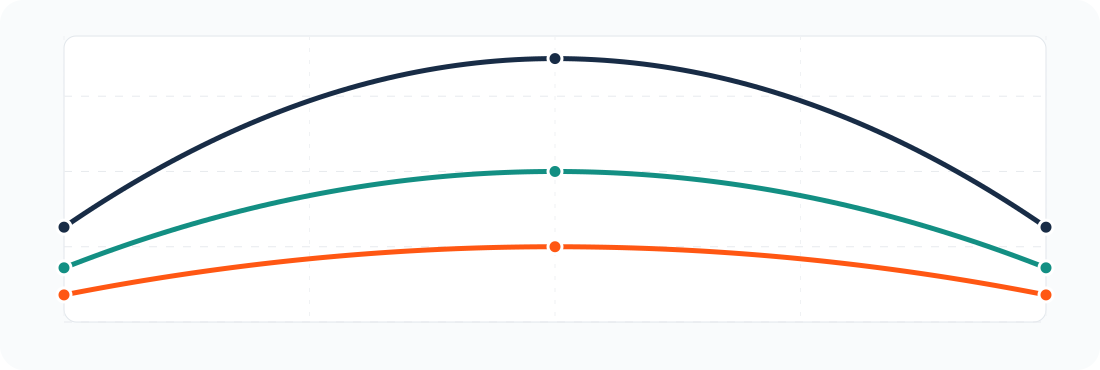
The HypaForecast illustration gives 0.18,0.50 and 0.18 USDC at constant normalized prices 0.10,0.50 and 0.90. The other rows are dated, product-specific examples in their stated denominations, not matching live quotes. A low illustrative fee does not establish a universal lowest-cost venue: executable size, price movement, currency conversion and funding costs can change the result.
Worked HypaForecast example: buy, win or lose
Fee basis: HypaForecast-supplied fee implementationv1.1 and 26 October 2026 operator confirmation; the following is a simplified illustration.
Consider 100 hypothetical contracts with normalized p_H fixed at 0.50 and a pre-fee unit cost also fixed at 0.50 USDC. Ignore overround and price movement; these extra assumptions do not describe a general AMM fill. At k_H = 0.02, the entry fee is 100 × 0.02 × 0.50 × 0.50 = 0.50 USDC. Assume a winning contract pays 1 USDC, redemption fees are zero, and the position is held to resolution. The zero redemption charge is an assumption, not a confirmed live setting. External funding, conversion and network costs are excluded. CLOB maker 0% remains the separate operator-confirmed policy; an AMM limit fill is not automatically free. 1
| Step | Calculation | Amount |
|---|---|---|
| Purchase amount | 100 × 0.50 |
50.00 USDC |
| Entry AMM taker fee | 100 × 0.02 × 0.50 × (1 − 0.50) | 0.50 USDC |
| Total entry cost | 50.00 + 0.50 |
50.50 USDC |
| If correct: contract payout | 100 × 1.00 |
100.00 USDC |
| If correct: net profit | 100.00 − 50.50 |
+49.50 USDC |
| If wrong: contract payout | 100 × 0 |
0.00 USDC |
| If wrong: net P&L | 0.00 − 50.50 |
−50.50 USDC |
What matters is that the displayed 0.50 contract price does not already include the modeled 0.50 taker fee. The fee raises total entry cost to 50.50, so the winning gain is 49.50—not the gross 50.00 difference between purchase price and winning payout. A complete account-level calculation would also include applicable external funding and withdrawal costs.
What if you sell before resolution?
An early exit requires another fill. Keep the simplified 100-contract entry cost of 50.50 USDC. Each hypothetical AMM exit holds its normalized price constant at the stated sale price, also treats that as the raw unit price, and omits overround and price movement. The CLOB maker exit rows instead assume an actual maker fill with 0% fee. Neither a specified-price fill nor maker classification is guaranteed; AMM limit orders use the AMM fee. All table amounts are USDC. 1
| Exit scenario | Gross sale | Exit fee | Net proceeds | Net P&L vs 50.50 entry |
|---|---|---|---|---|
| AMM taker: sell 100 at constant 0.60 | 60.00 | 0.48 | 59.52 | +9.02 USDC |
| AMM taker: sell 100 at constant 0.40 | 40.00 | 0.48 | 39.52 | −10.98 USDC |
| Maker: sell all 100 shares at 0.60 | 60.00 | 0.00 | 60.00 | +9.50 USDC |
| Maker: sell all 100 shares at 0.40 | 40.00 | 0.00 | 40.00 | −10.50 USDC |
The maker rows keep the original taker entry cost of 50.50 USDC; only the exit fee changes. A resting sell order may never fill, so a lower fee is not a guarantee of a better realized outcome. On markets where a sale consumes several book levels, use the actual weighted-average sale price. Whether you can sell before resolution at a particular price depends on the market and the current available orders.
The displayed price may not cover your order
Displayed probabilities are not two executable buy quotes. Polymarket international's price documentation distinguishes a midpoint or last-trade display from the ask used when buying and the bid used when selling. A displayed YES probability p and its arithmetic complement 1 − p sum to 1, but that calculation does not establish the prices at which YES and NO can both be bought. Compare the actual bid or ask for each outcome in the same binary market, denomination and time window, and the size available at that quote; a larger order may reach worse levels. Explicit trading fees are separate. This documentation example does not establish Polymarket US or HypaForecast display conventions.
Suppose an order book shows a best ask of 0.50 for only 40 shares. You want 100 shares immediately, so the rest fills at higher levels. Here is a hypothetical depth model, not HypaForecast live liquidity or a promise of matching behavior. Prices and executed amounts are in USDC.
| Ask price | Shares actually filled | Executed amount |
|---|---|---|
| 0.50 | 40 | 20.00 |
| 0.52 | 40 | 20.80 |
| 0.54 | 20 | 10.80 |
| Total | 100 | 51.60 |
Weighted-average execution price =51.60 ÷100 =0.516 per share. The table alone does not supply the normalized AMM price path, so it cannot determine HypaForecast’s actual fee or total charge. Use the applicable quote rather than applying 1% to 51.60 or plugging its average raw price into the integral. Using the best ask alone would understate the pre-fee fill amount by 1.60. That difference is already in 51.60 and must not be added again as an arbitrary slippage charge.
The spread measures the best bid-to-ask gap; depth measures how many shares are available at different prices; volume measures what already traded. Therefore volume is not depth or immediately available liquidity. A fair venue benchmark needs the same question, comparable rules, order size and timestamp, not just a fee table.
Break-even selling price with two taker fees
For a conditional break-even illustration, keep the same constant normalized entry at 0.50 and assume each exit also has a constant normalized price s equal to its raw unit price. Omit overround, price movement, currency rounding and external costs. With coefficient 0.02 on both fills, the per-contract equation is:
0.50 + 0.02 × 0.50 × 0.50 = s − 0.02 × s × (1 − s)
Thus 2 s² + 98 s − 50.50 = 0 for 100 contracts, giving s ≈ 0.5099980008. At exactly 0.51, modeled net proceeds are 50.5002 USDC: only 0.0002 above the 50.50 entry cost before external costs. No currency rounding rule, price tick or available fill is assumed. Actual AMM paths, partial fills or outside charges require their own quote and calculation.
For a general buy/sell scenario with known entry and exit fees, use:
Net exit P&L = quantity × actual sell price − exit fee − (quantity × actual buy price + entry fee)
To find a settlement win/loss, replace sale proceeds with the outcome payout and omit an exit execution fee if no separate sale occurs; add a settlement charge only if the applicable schedule actually specifies one.
Full-cycle cost: from funding to withdrawal
A low trading fee does not guarantee a low total cost once you deposit and withdraw. Keep a money-path ledger rather than blindly adding percentages:
- Funding: Amount sent, currency, payment rail and credited amount. A provider may deduct its own fee before trading balance appears.
- Conversion: If an asset/currency/chain is swapped or bridged, record the received quantity and any quoted conversion spread, network fee or routing charge.
- Entry: Record fill quantities, actual average fill price and the platform's entry fee by maker/taker status.
- Exit or resolution: Record actual sale proceeds, any exit fee, or the event-rule payout; settlement fees only if stated.
- Withdrawal: Record amount sent from available balance, provider/platform deduction, and final receipt after network or banking costs.
A withdrawal quote is not necessarily the provider's actual network expense. For example, Coinbase Exchange's withdrawal disclosure (checked 23 October 2026) says its customer charge is based on an estimate; the network fee it ultimately pays can differ because of batching or changing congestion. This is a Coinbase Exchange example, not a HypaForecast fee policy. In your ledger, check whether a network cost is already included in the quoted withdrawal charge or is explicitly additional, and count an included cost only once.
On HypaForecast, positions use USDC on Solana, while funding can originate from multiple supported crypto assets or chains. Account creation and transaction eligibility are separate. Check the current verification and linked-wallet requirements before funding or trading. Funding routes and balances are different from the final position asset. Funds committed to orders, positions, fees or settlement may be unavailable for withdrawal until released. Withdrawals may be subject to minimums, fees and network charges, compliance checks, wallet screening, processing times, liquidity, blockchain availability and supported-network restrictions. Processing a withdrawal and receiving it externally are separate steps; do not assume immediate final receipt. Rulebook Terms Verify the specific asset, route and quote before assuming a cost.
On Polymarket international, the fee documentation describes no platform charge to deposit or withdraw USDC, but providers and conversion/bridge routes can still charge. Its trading collateral is pUSD on Polygon, backed by USDC; the deposit asset, trading collateral and final received asset are different parts of the money path. 12 On Kalshi, the July fee PDF lists no settlement fee and no Kalshi ACH deposit/withdrawal fee, while card and third-party rails may involve costs. Robinhood has venue-specific exchange fees in addition to broker commission. These are different money paths; do not apply one platform's rails to another.
A complete 100 USDC cash-flow example
Hypothetical cash-flow example, not a funding or withdrawal quote. Start with 100 USDC of external outlay and assume an invented 1 USDC provider deduction before funding and 0.20 USDC on withdrawal. Buy 100 contracts at constant normalized/raw price 0.50, then sell all 100 at constant normalized/raw price 0.60, with coefficient 0.02 on each fill. Omit overround, price movement, currency-value changes and other external costs. These conditions reproduce the earlier illustration, not a general executable AMM order. The external deductions are not HypaForecast or provider fee claims. 1
| Stage | Calculation | Amount (USDC) |
|---|---|---|
| Total external outlay | Starting amount sent | 100.00 |
| Assumed external funding deduction | Illustrative provider cost | −1.00 |
| Trading balance credited | 100.00 − 1.00 |
99.00 |
| Taker purchase, including entry fee | 100 × 0.50 + 0.50 |
−50.50 |
| Unused trading balance | 99.00 − 50.50 |
48.50 |
| Net sale proceeds | 100 × 0.60 − 0.48 | +59.52 |
| Available balance before withdrawal | 48.50 + 59.52 | 108.02 |
| Assumed external withdrawal deduction | Illustrative outward-transfer cost | −0.20 |
| Final external receipt | 108.02 − 0.20 | 107.82 |
| Full-cycle net P&L | 107.82 − 100.00 | +7.82 |
The reconciliation is 9.02 USDC trading profit −1.00 assumed external funding cost −0.20 assumed withdrawal cost =7.82 USDC. The 48.50 unused balance is part of the withdrawal, not extra profit. Do not sum the table’s cash movements and intermediate balances. No separate slippage charge or settlement charge is added to this sale-based example.
How to compare fees fairly
Start with the same real user decision, not the platform that has the lowest-looking column. Confirm the following before declaring a winner:
- Exact product and market: Polymarket US vs international; Kalshi series; HypaForecast category; AMM vs order-book route; applicable effective date.
- Same executable order: $1 winning payoff where genuinely comparable, the same Yes/No side, timestamp, contract quantity, actual buy or sell fill and maker/taker status.
- Complete fee base: Whether a published coefficient multiplies premium, contracts, payout or
p × (1−p); any minimum, cap, rounding, rebate and fee currency. - Whole trade path: Entry, likely exit vs hold-to-resolution, spread/depth, funding conversion and withdrawal. Do not double-count spread or slippage after using fill prices.
- Account-specific conditions: Memberships, promotions, access restrictions, eligible markets, settlement terms and provider-dependent charges.
If any of these cannot be verified for the trade, write “unknown for this order” rather than inventing an all-in lowest-cost platform. You can investigate Kalshi alternatives or Polymarket alternatives when the product or access route also needs to change.
Common mistakes that change P&L
“0% fee means zero trading cost.” A zero platform fee does not eliminate the bid–ask spread or an adverse fill. “A limit order is always maker.” A marketable limit can take available liquidity. “A 7% coefficient means 7% of my stake.” Price-dependent formulas use a different base. “I made 10 cents per share, so that's my net profit.” You may have entry and exit fees and worse execution. “The published comparison applies to every market.” Fee categories, product versions, maker rewards and series multipliers differ. “The deposit network is the trading network.” A bridge/conversion stage may separate the two.
Frequently asked questions
Do prediction markets charge both when buying and when selling?
Some platforms charge for each qualifying execution, so buying and later selling may incur two execution-fee events. An order held to resolution does not necessarily have an exit trading fee. Check the exact venue and any separate settlement fee.
Are prediction market maker orders free?
Sometimes. Polymarket international's current general documentation specifies 0% maker trading fees, while the Kalshi general maker multiplier defaults to zero except listed series. Other programs can charge, reward or vary by market. A resting order also may not fill.
Is Polymarket free to trade?
Not universally. The international platform publishes category-based taker fees with a separate fee-free geopolitics category, while Polymarket US has its own schedule. Third-party funding and execution costs can still exist. See the exact product, category and fee parameters before placing an order.
Is Kalshi’s taker fee 7% of the amount I invest?
No. The general formula is M × 0.07 × contracts × p × (1−p), subject to its rounding and series rules. For example, the general fee table shows 1.75 on 100 contracts at 0.50; that is not 7% of the 50-dollar premium.
How much are HypaForecast trading fees?
HypaForecast confirmed on 26 October 2026 that current markets use AMM coefficient 0.02 and its CLOB maker fee remains 0%. The AMM fee integrates 0.02 × p_H(x)(1 − p_H(x)) over the filled quantity; p_H is normalized from raw outcome prices. This is not flat 1% or 2% of the traded amount, and AMM limit fills are not automatically maker-free. The 50-cent entry example requires the stated constant-price/no-overround assumptions. Redemption and external costs are separate; check the actual quote. 1
Can a higher advertised fee still lead to a better trade?
Yes. A better execution price, smaller spread, deeper available orders or cheaper funding can outweigh the difference in explicit fees. Compare estimated net proceeds at the actual size, not just percentage labels. This article does not measure a live liquidity winner.
Next step: inspect the trade and its costs
Before committing funds, review the market's current price, order size, quoted fees and event rules. If the order or funding route is unavailable, the comparison is no longer like-for-like.
Explore HypaForecast markets
Browse markets, or check the question and current round details for the 5-minute and 15-minute BTC markets.
Sources and fee-comparison methodology
HypaForecast’s current formula uses its supplied implementationv1.1 and 26 October 2026 operator confirmation, not a live transaction test or a proven deployment start date. Competitor source checks remain 9 October 2026, with Polymarket international and US rechecked 16 October 2026; none was freshly reverified for this update. HypaForecast’s fixed-price examples explicitly omit overround and price movement and assume any stated redemption charge; they are not actual AMM quotes. Other products retain their own dated currency, formula, market and rebate conditions. No cross-currency equivalence, universal eligibility or lowest-cost outcome is established.
- HypaForecast fee implementationv1.1 and operator confirmation,26 October 2026. The operator confirmed deployment, current all-market AMM coefficient 0.02 and unchanged CLOB maker 0%. The supplied code defines the normalized path integral, BUY/SELL treatment and separate redemption setting; it is not an independently observed production transaction. The 9 October first-party fixed 1% specification is historical and no longer used as the current taker formula here. HypaForecast product site is an access link, not a public document containing the supplied code or every fee setting. Current redemption/withdrawal charges are not established by the coefficient confirmation.
- Polymarket international fee schedule — category coefficients, maker treatment, USDC-denominated fee examples and five-decimal precision; check the market's own fee parameters. Fee documentation checked 16 October 2026. The general precision statement does not specify halfway ties; exact market parameters and fee collection are separate questions.
- Kalshi event-contract fee schedule (PDF) — effective 7 July 2026; general taker/maker formulas, series multipliers, funding and settlement provisions. Its small-fill rounding text should be read with the actual order ticket. Checked 9 October 2026.
- Polymarket US exchange fee schedule — Standard taker formula, separate combo and Table Tennis terms, and fee rounding. Examples exclude combos and Table Tennis. Combo fills carry no maker rebate. Checked 16 October 2026, including the 19 October future rebate changes and the expired 15 October crypto promotion.
- Robinhood event contracts overview — 1 June commission model, per-contract cap, rounding and additional exchange fees. Gold subscription costs are not allocated to the example orders. Checked 9 October 2026.
- Limitless fees — CLOB and AMM treatments, including fee-asset differences. Inspect the selected market quote. Checked 9 October 2026.
- FanDuel Predicts payouts and fees — Checkout fees use potential payout; early cash-out fees use the cash-out payout. Check each preview separately rather than carrying the maximum winning payout into an early-exit calculation. Checked 9 October 2026.
- Public prediction market trading fees — $0.02 per traded contract, comprising exchange and broker components. Checked 9 October 2026.
- Polymarket international current fee types — sports versions and the October NFL/NCAAF exception. Checked 16 October 2026; event counts and fees can change.
- Polymarket market details — market-level fee enablement, rate, exponent, taker-only flag and rebates. Checked 16 October 2026; documented examples are not a live market quote.
- Polymarket market-buy spending — pre-fee purchase amount, fees charged additionally and an all-in spending cap. Checked 16 October 2026; current documented API/SDK route.
- Polymarket USD collateral — pUSD, Polygon and USDC backing. Checked 16 October 2026; this does not make bank dollars and collateral interchangeable.
- HypaForecast — Terms (3.3 / 5.2 / 7.1); document last updated 17 June 2026; observed 26 October 2026. Published instructions, not an independent account or transaction test.
- HypaForecast — Rules (6.2–6.3); document last updated 17 June 2026; version 1.4.0; observed 26 October 2026. Published instructions, not an independent account or transaction test.
For adjacent topics, read how to trade prediction markets or best prediction markets. Neither replaces checking the current order ticket and terms of the exact product you intend to use.
Share this guide