On this page
Quick answer: the trading journey
To trade prediction markets, choose a platform you can use, open a market and read its resolution rules. Understand the price, fund your account, choose an order type, check the full cost and submit. Confirm what actually filled. Then manage the position: sell before trading closes if liquidity allows, or hold through resolution. Withdraw only the funds that become available.
The key distinction is simple: an order is a request, a position is what you own, and a withdrawal moves available funds out of the platform. They are not the same action.
- 1–3Choose and understandEligibility · rules · price
- 4Fund the right balanceAccount · asset · route
- 5–7Order and check fillsPrice control · depth · fees
- 8–10Manage and finishExit or resolve · withdraw
This guide explains ordinary, fully paid binary contracts, with HypaForecast as a concrete funding and fee example. Order-book examples illustrate exchange-style trading; matching, supported order types and settlement procedures vary by platform. It does not cover leveraged products, perpetual futures or complex multi-leg contracts.
A prediction market trade in 60 seconds
A binary contract is tied to a specific outcome. In the usual $1-payout model, the winning side pays $1 per contract and the losing side pays $0. The market’s rules also explain how exceptional outcomes are handled. A position is not ownership of the team, currency or company named in the question. [11] [12]
Here is a hypothetical, fee-free example, not a current quote. Buy 10 YES contracts at $0.60 each and you spend $6. If YES wins under the rules, the $10 payout leaves a $4 profit. If YES loses, the payout is $0 and the loss is $6. Buying NO instead means holding the side that wins when the defined YES condition is not met. Its own purchase price determines its cost.
Selling an existing YES position removes the quantity you sell; it is not the same instruction as opening a new NO position. Check the action and resulting position rather than relying on the outcome label alone.
Step 1. Choose a usable platform and a clear market
Before funding, check the platform’s residence, location, age and identity requirements, plus the routes for depositing and withdrawing. A website loading or offering your language does not by itself confirm that you can complete those steps.
Choose a question you can understand and follow. A familiar topic is useful, but familiarity is not proof that your estimate is better than the market price. Start by writing down what would make the contract win, when that can be determined and how much you could lose.
For a platform-selection decision, use the dedicated comparisons of Polymarket vs HypaForecast or Kalshi vs HypaForecast. This guide focuses on executing and managing a trade, not ranking platforms.
Step 2. Read the resolution rules—not just the headline
Check the exact outcome definition, named source, observation window and timezone. Note when trading closes, when the result is determined and how postponements, cancellations or unavailable data are handled. Polymarket’s rules guide distinguishes the market title from the criteria that decide the result; Kalshi likewise explains that market close and determination can occur at different times. [12] [9]
Use this short checklist before choosing a side:
| Read | Question to answer |
|---|---|
| Outcome definition | Does “above” exclude an exact tie? Does a date include the whole day? |
| Resolution source | Which publication, data feed or official result controls? |
| Observation window | Is the contract about one observation, a closing value or an average? |
| Timing | When does trading stop, and when can the result become final? |
| Exceptions | What happens after a cancellation, correction or missing source? |
For example, “the final value is above the opening value” and “the average value is above the opening value” are different conditions. One last upward move need not make the average higher. This is a hypothetical distinction, not a statement about the rules of a current Bitcoin market.
Do not trade an ambiguous question until its rules answer the uncertainty that matters to you. Keep the relevant wording or a link for later reference.
Step 3. Understand price, probability and payoff
For a contract paying $1 if successful, a price of $0.60 is commonly read as roughly 60% market-implied probability. It is a market estimate, not an objective probability or a guaranteed forecast. A high price also leaves less gross upside to the $1 payout. [3]
A fee-free purchase at $0.95, for example, has at most $0.05 upside and $0.95 downside per contract under the ordinary binary model. “Likely to win” and “good value at this price” are different judgments.
Also distinguish the displayed price from an executable quote. Polymarket documents that its headline price can represent the bid–ask midpoint or, with a wide spread, the last trade. Other interfaces can display prices differently. Read the order preview and quantity available rather than assuming a chart price is the price for your entire order. [3]
Step 4. Create and fund the right account balance
The funding path depends on the platform. Identify what you send, which network or provider handles it, any conversion required, and the balance you will actually trade with. Check the return route before committing funds.
On HypaForecast, you can sign up with an email address, a supported social account or a wallet. Creating an account and meeting the requirements to deposit or trade are separate. Depositing and trading require a wallet linked to the same account and a verified Google, email or Telegram sign-in method. If you signed in with a wallet only, add one of those verified methods to that account. Sign-in verification is separate from eligibility and any additional identity or compliance checks. Account guide Add-funds guide Terms Positions use USDC on Solana. Funding can start from multiple supported crypto assets and chains, but the final trading balance is Solana USDC. [1]
That means “I can deposit this asset” does not mean “my position is denominated in this asset.” Follow the current funding instructions for the selected route; confirm the asset, network, destination and quoted net amount. Do not copy an address or network from an unrelated deposit method.
HypaForecast withdrawals require an external receiving wallet address, even when an external wallet was unnecessary at sign-up. The requirements belong to different stages of the journey. [13]
Need country-specific access, verification and funding guidance? Use how to trade prediction markets in Nigeria for the Nigeria workflow rather than treating this global guide as a local payment or eligibility approval.
Step 5. Choose price control or immediate execution
Where offered, a market-style order seeks available liquidity now. A limit order specifies the highest contract price you will pay when buying, or the lowest you will accept when selling. Neither label promises that the full quantity will execute. Kalshi’s limit-order guidance explicitly notes the risk of no fill; Polymarket’s order instructions distinguish orders that rest from those that must fill immediately or cancel. [6] [4]
| Order approach | What it prioritizes | What to check |
|---|---|---|
| Market or immediately executable order | Trading against available quotes now | Average price, size available, price protection and treatment of any remainder |
| Limit buy | A maximum contract price | Whether anything is available at or below that price; fees can be additional |
| Limit sell of an owned position | A minimum contract price | Whether buyers are willing to meet it; only the filled quantity is sold |
A limit order can execute immediately if its price crosses the other side’s quote. “Limit” does not automatically mean “maker” or “free.” Maker and taker describe whether a fill adds resting liquidity or consumes it. A single order can have an immediately filled portion and a remainder that rests. [4]
Check how the venue handles unfilled quantities, order expiry and cancellation. Do not assume every website exposes the same options as another platform’s API.
Step 6. Check spread, depth and total cost
Spread: the gap between buying and selling
The best bid is the highest available buying offer; the best ask is the lowest selling offer. Their difference is the spread. [3]
In a separate hypothetical example, suppose the bid is $0.49 and the ask is $0.51, with enough quantity available. Buying 10 at the ask costs $5.10. Selling them immediately at an unchanged bid returns $4.90: a $0.20 loss before fees, even without a news-driven price move.
Depth: the first price is not the whole order
An immediate order can fill at several prices when the best level has insufficient quantity. Kalshi’s Quick Orders guide describes this effect. [5]
Here is this guide’s own hypothetical order book, with all fees excluded. You want to buy 120 contracts, and the available asks are:
| Available contracts | Price per contract | Cost at this level |
|---|---|---|
| 30 | $0.48 | $14.40 |
| 50 | $0.50 | $25.00 |
| 40 | $0.53 | $21.20 |
| 120 total | $0.505 average | $60.60 total |
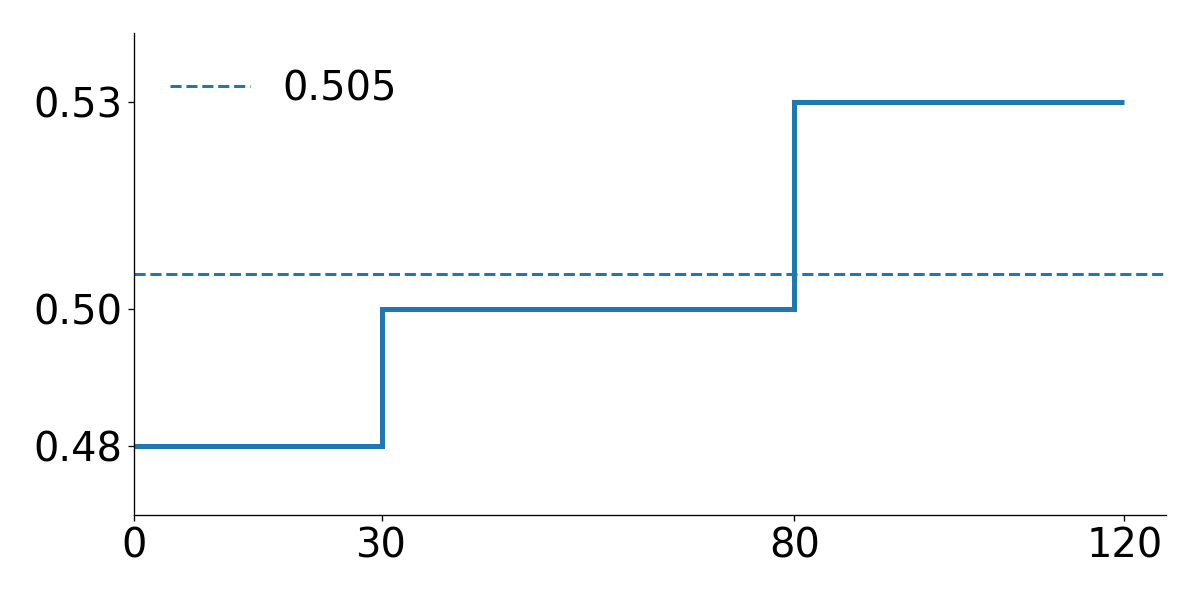
The arithmetic is (30 × 0.48) + (50 × 0.50) + (40 × 0.53) = 60.60. Divide by 120 to obtain the $0.505 average execution price, before fees. The first $0.48 quote alone would suggest $57.60 for 120 contracts—$3.00 less than the full-book cost.
With a $0.50 buy limit, at most the first 80 contracts in this unchanged hypothetical book can fill immediately, for $39.40 before fees. The remaining 40 cannot fill at $0.53 under that limit; they may rest or cancel depending on the instruction. Prices and quantities can change before an actual order arrives.
Immediate or cancel (IOC) versus fill or kill (FOK). Price control and immediate completion are separate conditions. In Euronext Athens’ continuous Main Board trading, IOC cancels any unexecuted remainder; FOK requires the whole order to execute on entry or be canceled. Check the venue’s definition and supported options: these securities-market rules do not establish that HypaForecast offers either instruction. [14]
Apply those definitions separately to fresh copies of the unchanged book above. Assume a valid order, sufficient buying power, a starting position of zero and all 80 contracts at or below $0.50 immediately executable. IOC buys those 80 for $39.40 before fees and cancels the remaining 40; the position stays at 80. FOK buys none and cancels all 120 because the full quantity cannot execute immediately within the same limit. Cancellation does not undo completed fills, and FOK neither guarantees a trade nor leaves an all-or-none order waiting for later liquidity.
Trading volume describes past activity; the relevant question for an order is the quantity executable now at acceptable prices. Slippage is the difference between the execution price you expected and the price at which your order actually fills; thin depth and changing quotes can contribute. Use the full-size order preview as your reference rather than just the first quote, and do not add slippage again as a separate platform fee when calculating from actual fill prices.
Fees: do not count the same cost twice
Compare contract cost and explicit trading fees with any funding, conversion, network, settlement/redemption or withdrawal charges that apply to the chosen route. Not every platform charges each category. Some Kalshi markets, for example, charge maker fees, so a resting order is not universally fee-free. [8]
The spread and depth effects are already reflected in the actual buy and sell prices. Do not subtract a second “spread charge” from a profit calculation that already uses those fill prices. Check fees separately, and distinguish a quote from the final amount charged.
Step 7. Submit the order—and inspect the fills
On HypaForecast, select an outcome and review the order preview before placing the trade. Check the intended market and round, direction, quantity, available balance, estimated cost and fee. [2]
After submission, reconcile the order history with your position. These are different states:
| State | Meaning for your next action |
|---|---|
| Submitted or pending | A request exists; do not assume the position is complete. |
| Partially filled | Only the filled quantity has been bought or sold. Manage the remainder separately. |
| Fully filled | Check the average execution price and actual fees, not just the original preview. |
| Canceled or expired remainder | Unfilled quantity is no longer pending; completed fills have not been undone. |
Return to the 120-contract example. If only 80 filled, you own 80—not 120. Canceling the remaining 40 does not sell the 80 you already bought. Exact status labels and when cancellation is allowed depend on the venue; some pending orders cannot be canceled during a processing delay. [4] [6]
Before resubmitting an apparently stuck order, check whether the first request filled. A second request could otherwise create more exposure than intended.
Step 8. Monitor, sell early or deliberately hold
Keep track of your filled quantity, purchase cost including fees, the relevant rules and the current executable exit price. Treat a displayed position valuation as an estimate, not money already received.
You do not always have to wait for resolution. Selling an owned position can realize a gain or loss earlier, but requires trading to remain available and executable buying interest. Kalshi’s sale guide makes the counterparty requirement explicit. [7] [11]
If you offer 100 contracts and only 40 sell, you still hold 60. An order submission is not a completed exit. Recheck any open buy or sell orders as well as the position itself.
Choose the trade-off consciously: selling uses the prices and fees available now; holding keeps exposure to the eventual result and ties up the position until it can be sold or settled. A price-controlled exit can remain unfilled. Neither path guarantees a profit.
Step 9. Confirm resolution and settlement
Event end, trading close, official determination and balance credit can occur at different times. Kalshi describes settlement after the official result is confirmed; Polymarket has a resolution process that can include challenges before redemption. Do not borrow one platform’s timetable for another. [9] [12]
For an ordinary winning binary contract, check the credited payout against the quantity still held at settlement and the contract’s stated face value. For a losing contract, the ordinary payout is zero. Exceptions such as a cancellation or ambiguous result follow the market’s rules; do not assume either a full refund or a standard $1/$0 outcome in every case.
A filled sale removes that quantity. The remainder stays exposed.
The contract’s final result determines the payout.
If a market looks finished but the balance has not changed, inspect its status, determination source and timing. Record the market and position details when contacting support. An apparent real-world result is not, by itself, proof that settlement has completed.
Step 10. Withdraw available funds and check receipt
Selling or settlement can create an account balance; it does not mean money has already reached an external wallet or bank. Open positions, reserved amounts or account holds may affect what is withdrawable. Kalshi’s withdrawal guidance, for example, distinguishes settled cash and deposit-related holds. [10]
For HypaForecast, funds committed to orders, positions, fees or settlement may be unavailable for withdrawal until released. Withdrawals may be subject to minimums, fees and network charges, compliance checks, wallet screening, processing times, liquidity, blockchain availability and supported-network restrictions. Processing a withdrawal and receiving it externally are separate steps; do not assume immediate final receipt. Rulebook Terms
Confirm the receiving address and network, the requested amount, deductions and the expected net receipt. Keep the withdrawal reference and verify the receiving account. A wallet’s USDC receipt is also distinct from a later conversion to bank money through another service; that separate route can have its own eligibility, timing and cost.
Worked example: HypaForecast fees and your remaining balance
In the formula below, C is the filled contract quantity.
For HypaForecast, p_H is the contract’s raw price divided by the sum of all outcomes’ raw prices; a NO contract uses the complementary outcomes as one contract, without repeated YES-component fees. Its current coefficient is k_H = 0.02, confirmed by HypaForecast on 26 October 2026. The AMM fee is F_H = k_H × ∫₀^C p_H(x)(1 − p_H(x)) dx along the BUY or SELL inventory path. The raw execution price can differ from p_H. Neither k_H = 0.02 nor the old compatibility setting tradeFeeRate = 0.01 means a flat notional percentage. This is supplied-code analysis and dated operator confirmation, not an independent live trade. Fee basis
HypaForecast also confirmed that its CLOB maker fee remains 0%. This is separate from the AMM fee: a limit order that fills against the AMM uses the same price-dependent calculation, so a limit order is not automatically maker-free. BUY adds the AMM fee to the pre-fee cost, while SELL deducts it from gross proceeds. A round trip can incur fees on both fills. Fee basis
Assume you already have 100.00 USDC available after funding. You buy 100 contracts at a raw unit price of 0.50 USDC, all as AMM taker fills. For this simplified example, normalized p_H also stays at 0.50 throughout the fill; omit overround and price movement. Only under these assumptions does the entry fee simplify to 100 × 0.02 × 0.50 × (1 − 0.50) = 0.50 USDC. This is a calculation example, not an executable AMM quote.
| Entry | USDC |
|---|---|
| Contract purchase: 100 × 0.50 | 50.00 |
| Buy fee: 100 × 0.02 × 0.50 × 0.50 | 0.50 |
| Total spent | 50.50 |
| Unspent balance | 49.50 |
The four rows below are alternative outcomes, not sequential trades. Both early-sale rows assume all 100 contracts sell as AMM taker fills. Within each hypothetical sale, normalized p_H stays constant at the stated raw sale price, with overround and price movement omitted. For the two settlement rows only, assume the normal winning payout is 1.00 USDC per contract and there is no additional settlement/redemption charge. Zero redemption fees are an example assumption, not a verified live setting for every market. Check the actual contract and charges.
| Alternative outcome | Proceeds after modeled exit fee | Position profit/loss | Total account balance afterward |
|---|---|---|---|
| Sell at 0.60; sell fee 0.48 | 59.52 | +9.02 | 109.02 |
| Sell at 0.40; sell fee 0.48 | 39.52 | −10.98 | 89.02 |
| Hold; chosen outcome wins | 100.00 | +49.50 | 149.50 |
| Hold; chosen outcome loses | 0.00 | −50.50 | 49.50 |
At a constant normalized sale price of 0.60, the modeled sell fee is 100 × 0.02 × 0.60 × (1 − 0.60) = 0.48 USDC. For the first row, 60.00 − 0.48 − 50.50 = +9.02 USDC. Your unspent 49.50 plus net sale proceeds of 59.52 gives 109.02 USDC in the account, before any holds or further costs. At 0.40, the sell fee is also 0.48 USDC; net sale proceeds of 39.52 leave a position loss of 10.98 and a total account balance of 89.02 USDC.
These are modeled amounts, not live fills. Funding, conversion, network, withdrawal and tax costs are excluded; no additional spread/slippage is assumed beyond the stated execution prices. No platform-specific rounding behavior is inferred.
To follow the funds through withdrawal, suppose a hypothetical external deduction of 1.00 USDC applies when withdrawing the full 109.02. The received amount would be 108.02 USDC. The 1.00 is not a quoted HypaForecast fee. Real net receipt must use the actual route’s charges; starting with 100 USDC in the account does not tell you what it cost to acquire and deposit that amount.
Common mistakes to avoid
Buying the headline rather than the contract. A different source, observation window or tie rule can change which side wins.
Confusing payout, position value and profit. A 100 USDC payout is not 100 USDC profit. Subtract purchase cost and applicable fees; a current valuation is not a completed sale.
Using the first quote for the full size. Check the price ladder or complete order estimate, not just the headline probability.
Treating “limit,” “submitted” or “sell” as a guarantee. A limit may be a taker, submission may be pending, and a sale may fill only partly.
Sizing only for the favorable case. Before entering, account for the full possible loss, fees and other open positions affected by the same event. Several related contracts can lose together.
Frequently asked questions
Can you make money trading prediction markets?
A filled sale above your total cost or a favorable settlement can produce a profit. A loss is also possible, including the full cost of a position plus fees. Identifying the likely winner is not enough: entry price, execution and costs determine the result. The worked example shows both directions.
Can I sell before the event finishes?
Where the platform supports early trading, you can try to sell while the market is open. A successful exit requires executable liquidity at an acceptable price. Only the quantity that fills has been sold. [7]
How much do I need to start?
There is no universal minimum across platforms. Check the minimum order quantity, current contract price, fee and any funding minimum. The 100-contract examples in this guide illustrate arithmetic; they are not a recommended starting amount.
Do I need a crypto wallet?
Not for every platform. For HypaForecast, depositing and trading require a wallet linked to the same account and a verified Google, email or Telegram sign-in method. If you signed in with a wallet only, add one of those verified methods to that account. Sign-in verification is separate from eligibility and any additional identity or compliance checks. Account guide Add-funds guide Terms Plan withdrawals separately: HypaForecast needs an external receiving wallet address. [1] [13]
Is a $0.60 contract a guaranteed 60% chance?
No. It is a market-implied estimate for the specified payoff model, not a guarantee about the event’s true probability. The displayed price also may not be executable for your full quantity. [3]
What should I do before my first order?
Write down the exact winning condition, resolution source, intended quantity, maximum total spend including fees and what you will do with an unfilled remainder. Then decide whether you are prepared to hold if an early sale is unavailable. Inspecting a market does not require committing to a trade.
Ready to look at a real market?
Browse HypaForecast markets, or inspect the current question and round details for the 5-minute and 15-minute BTC markets.
Sources and calculation notes
Sources 1–13 retain their original reference dates: 6 October 2026, with receiving-wallet and security-hold details dated 3 October. Account requirements and withdrawal conditions were checked against the published documents on 26 October; their document dates are listed below. The current fee formula uses the supplied implementation and HypaForecast’s 26 October confirmation. These sources do not establish an independent live trade or a deployment start date. The hypothetical books and balances are calculations, not live quotes, liquidity measurements or actual trading results.
- HypaForecast historical first-party product baseline — Signup, funding/trading-asset and then-current fee information, 6 October 2026. Its fee description is superseded by the 26 October fee basis below; exact live route lists and fee rounding are not assumed.
- HypaForecast first-trade help — First-trade overview. Used for the outcome → preview → order sequence, not exact screen placement or matching settings.
- Polymarket — Prices & Orderbook — Official guide consulted 6 October 2026; applies to the named platform.
- Polymarket — Order Lifecycle — Official guide consulted 6 October 2026; applies to the named platform.
- Kalshi — Quick Orders — Official guide consulted 6 October 2026; applies to the named platform.
- Kalshi — Limit Orders — Official guide consulted 6 October 2026; applies to the named platform.
- Kalshi — Limit Order Sale — Official guide consulted 6 October 2026; applies to the named platform.
- Kalshi — Fees — Official guide consulted 6 October 2026; applies to the named platform.
- Kalshi — Market FAQs — Official guide consulted 6 October 2026; applies to the named platform.
- Kalshi — Withdrawal Hold Periods / Security Holds — Official guide consulted 6 October 2026; applies to the named platform.
- Polymarket — Positions & Tokens — Official guide consulted 6 October 2026; applies to the named platform.
- Polymarket — Resolution — Official guide consulted 6 October 2026; applies to the named platform.
- HypaForecast saved first-party funding / withdrawal roles — First-party receiving-wallet and security-review information, 3 October 2026; not a general country-eligibility statement.
- Euronext Athens — Order Types — Condition table, PDF page 5; checked 23 October 2026. IOC and FOK definitions apply to continuous Main Board trading, not HypaForecast feature support. Publication date not confirmed.
- HypaForecast — Account (If you signed in with a wallet first); document last updated 24 August 2026; observed 26 October 2026. Published instructions, not an independent account or transaction test.
- HypaForecast — Funds (Opening requirements and Platform balances); document last updated 24 August 2026; observed 26 October 2026. Published instructions, not an independent account or transaction test.
- HypaForecast — Terms (3.3 / 5.2 / 7.1); document last updated 17 June 2026; observed 26 October 2026. Published instructions, not an independent account or transaction test.
- HypaForecast — Rules (6.2–6.3); document last updated 17 June 2026; version 1.4.0; observed 26 October 2026. Published instructions, not an independent account or transaction test.
- HypaForecast-supplied fee implementation v1.1 and operator confirmation, 26 October 2026 — Formula and AMM limit-fill behavior from supplied-code analysis; deployed code, all current markets using coefficient 0.02, and unchanged CLOB maker 0% from dated operator statements. No independent live trade, proven deployment start date, live redemption setting or withdrawal/network charge is established by this evidence.
Share this guide